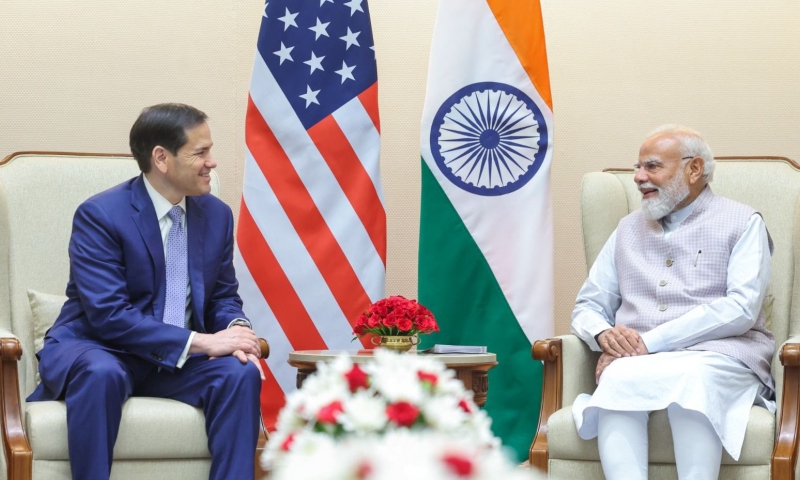
U.S. Secretary of State Marco Rubio called on Prime Minister Narendra Modi in New Delhi on Saturday, opening a high-profile India visit that was closely tied to bilateral cooperation and the Quad foreign ministers' meeting. The conversation covered both the India-U.S. partnership and the wider global situation.
Rubio briefed the Prime Minister on progress across defence, strategic technologies, trade and investment, energy security, connectivity, education and people-to-people ties. That range shows how the relationship has moved beyond a narrow diplomatic channel into a broad strategic and economic platform.
West Asia formed an important backdrop. The region's instability has direct consequences for India through crude prices, shipping routes, diaspora safety and foreign-exchange pressure. Modi reiterated India's support for peace efforts and peaceful resolution of conflicts through dialogue and diplomacy.
The meeting also carried political symbolism. Rubio conveyed the U.S. perspective on regional and global issues, while Modi asked him to convey greetings to President Donald Trump and said he looked forward to continued exchanges. At a time of economic and security uncertainty, high-level communication helps reduce surprise and keeps channels open.
For India, the visit is useful because it connects multiple tracks: energy, defence, education, connectivity and technology. For the United States, India remains a central partner in the Indo-Pacific and an increasingly important market and strategic voice.
The key issue will be follow-through. Meetings create visibility, but the value will be measured by technology access, resilient supply chains, stable energy coordination, student mobility, defence cooperation and India's ability to maintain its independent diplomacy while deepening practical ties with Washington.