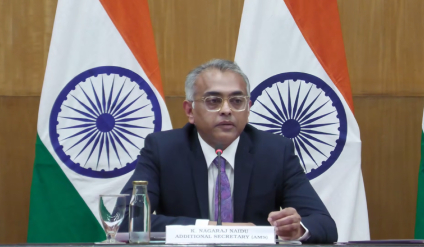
The Quad foreign ministers met in New Delhi on May 26, with talks beginning at 9:15 am local time and lasting about an hour, Japan's foreign ministry said. S. Jaishankar, Penny Wong, Toshimitsu Motegi and Marco Rubio represented India, Australia, Japan and the United States respectively.
Japan's account records discussion of the East and South China Seas and opposition to unilateral changes by force or coercion. Ministers also expressed concern about export restrictions affecting critical minerals. On Iran, they discussed safe navigation through Hormuz and diplomatic efforts to stabilise the Middle East, citing consequences for regional energy supplies.
North Korea was another substantive item. The ministers condemned its unlawful ballistic-missile and weapons programmes and expressed concern about malicious cyber activity. Australia, India and the United States backed an immediate resolution of the abductions issue. Motegi also outlined Japan's updated Free and Open Indo-Pacific approach.
The meeting factsheet sets out a new Indo-Pacific Maritime Surveillance Collaboration, initially focused on the Indian Ocean. It combines information sharing with specialist exchanges and tabletop exercises. The maritime-domain-awareness partnership is developing a common operating picture, while India is to host the next Quad-at-Sea Ship Observer Mission.
The minerals framework covers coordinated investment and economic-policy tools across mining, processing and recycling. A separate energy initiative identifies technology, management, policy, market analysis and emergency-response exercises as cooperation areas. The factsheet also announces work with Fiji's government on port infrastructure, following the October 2025 ports conference in India.
Technology measures extend beyond maritime surveillance. The partners reported selection of trusted suppliers for Palau's Open RAN project in February 2026 and proposed collaboration on next-generation communications standards, primarily 6G. A digital-identity workshop is intended to develop a technical translation guide for cross-border interoperability. These are distinct announced projects at different stages, rather than completed regional systems.