At the May 2026 World Health Assembly, countries renewed support for Immunization Agenda 2030 while warning that progress was off track. WHO's account described calls to reach children outside routine services, strengthen national funding and rebuild trust in vaccination.
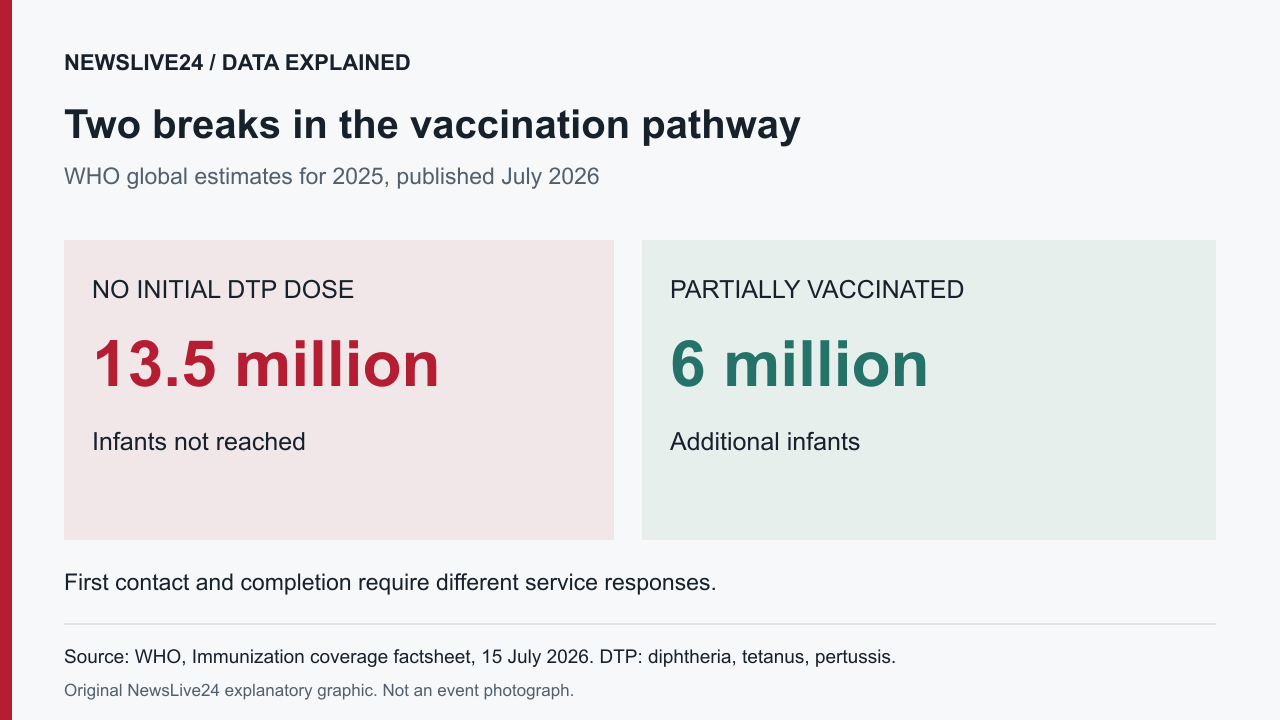
WHO's July 15, 2026 update estimated that 85% of infants received three diphtheria, tetanus and pertussis vaccine doses in 2025. It reported 13.5 million infants missing the initial DTP dose and another six million partially vaccinated.
These groups identify different service gaps: establishing contact and completing a series. Separating them helps programmes distinguish initial reach from continuity after a child has entered vaccination services.
WHO estimated first-dose measles coverage at 84% and second-dose coverage at 77% in 2025. Nearly 21 million children missed their routine first dose. The seven-percentage-point coverage gap is not an infection-risk estimate.
The assembly discussion connected vaccine confidence with the organisation of services. Delegates advocated community engagement, more reliable financing, regional manufacturing and closer integration with primary health care. Communication and access address distinct obstacles: a persuasive message does not deliver a dose where a functioning service is absent.
WHO recommends subnational monitoring to target gaps. District-level information can show where initial access or series completion needs attention even when national coverage changes little.
Delegates also described expanding digital immunization registries and vaccination across the life course, extending the discussion beyond infant coverage to protection at different ages. WHO's May account paired these developments with calls for targeted support in fragile and conflict-affected settings. Together, those priorities distinguish two planning needs: maintaining vaccination services as people grow older and directing additional support to places where routine services face disruption.