WHO's World Health Statistics 2026 report describes slowing, uneven progress despite gains against some diseases. Its May release records a 40% fall in new HIV infections from 2010 to 2024, but warns about affordable access to care.
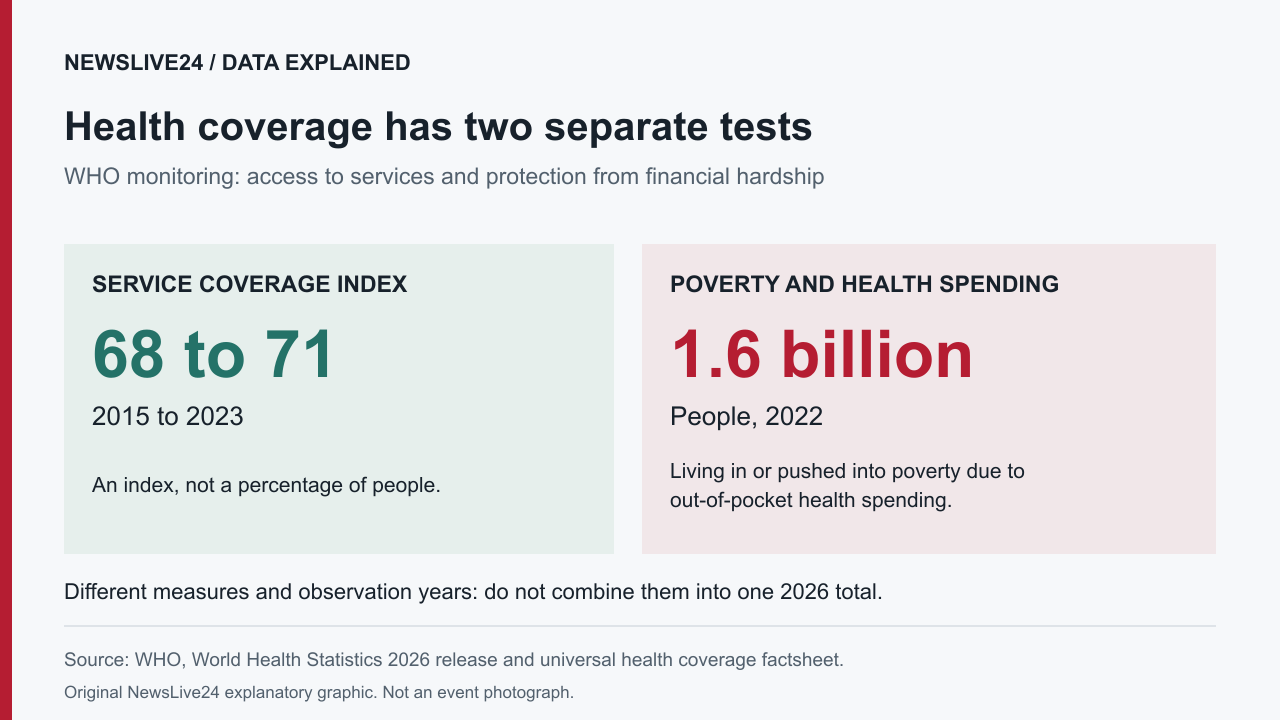
The global service coverage index rose from 68 to 71 between 2015 and 2023. Out-of-pocket spending left 1.6 billion people living in or pushed into poverty in 2022. These are different observation periods, not a single 2026 headcount.
WHO also says that by the end of 2025 only 18% of countries reported mortality data within one year. Late or incomplete records constrain comparisons. A missing observation cannot establish that a health problem has disappeared.
WHO defines universal health coverage through two connected requirements: people must be able to obtain the quality services they need, and doing so must not create financial hardship. Its monitoring framework consequently tracks service coverage and financial hardship separately. A country can improve one without making equivalent progress on the other.
The organisation's coverage fact sheet also cautions that national averages conceal inequalities within countries. This is why a rising national index does not establish that rural families, poorer households or people with disabilities can obtain care on equal terms. Nor does an aggregate improvement show which services remain difficult to access.
For readers evaluating a health-policy claim, the useful comparison is therefore not simply more hospitals versus fewer hospitals. Ask whether the evidence measures access, affordability or outcomes; which population it describes; and the year of observation. The report's central tension is that successful disease programmes can coexist with households still unable to secure affordable treatment. A single favourable statistic cannot resolve that contradiction.