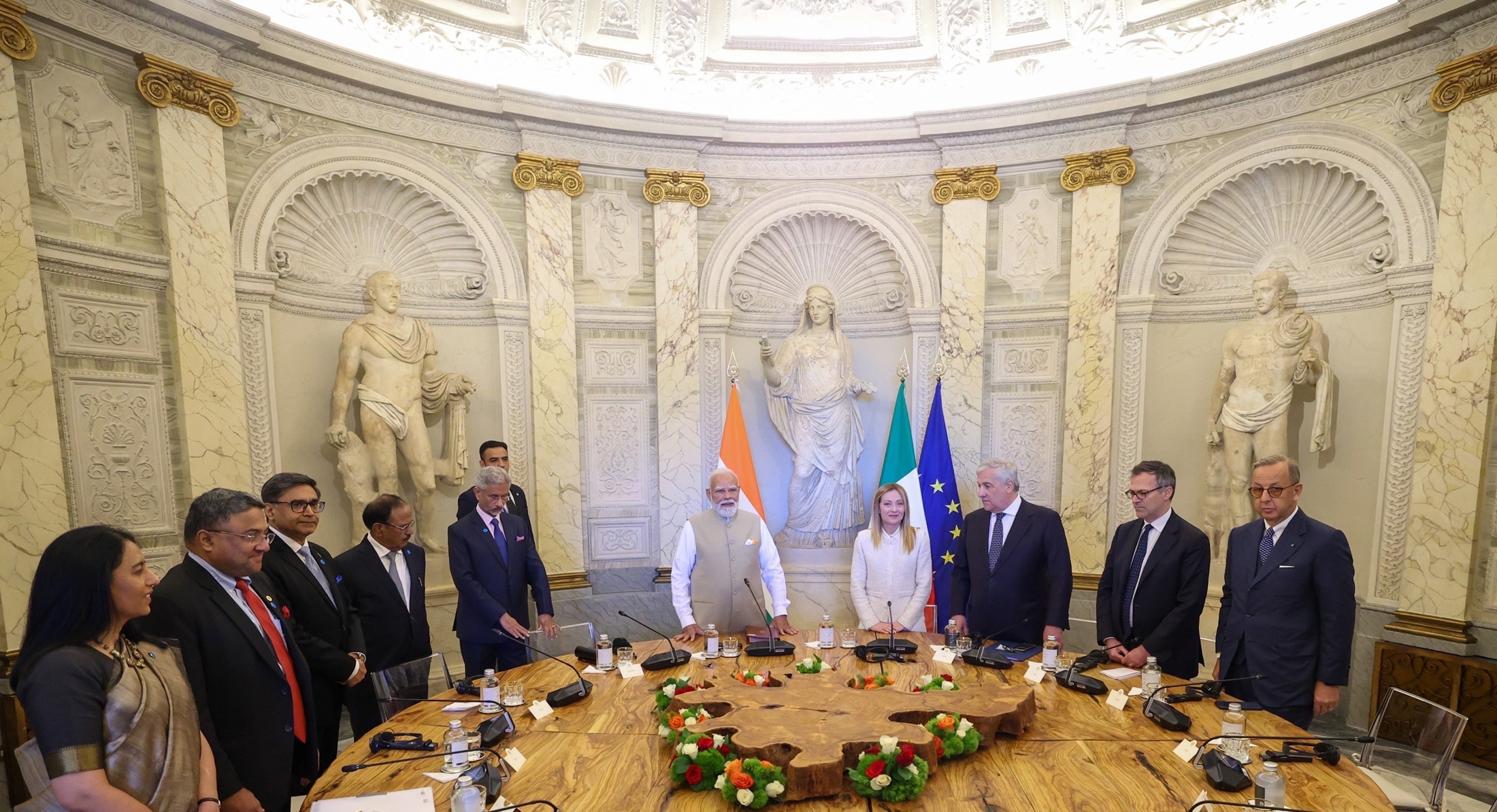
Narendra Modi and Giorgia Meloni set out an industrial agenda in their joint article published on May 20, linking Italian design and manufacturing with India's engineering workforce, market and innovation businesses.
They set an ambition to exceed EUR 20 billion in bilateral trade by 2029. They identified defence, aerospace, clean technology, machinery, automotive components, chemicals, pharmaceuticals, textiles and agri-food for expansion, alongside investments integrating companies into each other's supply chains.
Artificial intelligence occupies a prominent place in the article. The leaders advocate human-centred development, protection of individual rights and safeguards against manipulation of public debate. They also point to cooperation in quantum computing, space, renewable energy, hydrogen and digital infrastructure, linking research partnerships with industrial applications.
The India-Middle East-Europe Economic Corridor is presented as a connection involving transport routes, digital networks and energy systems. This gives the commercial agenda a geographic dimension: the two countries describe their Mediterranean and Indo-Pacific positions as complementary parts of a wider route connecting the Indian Ocean and Europe.
In later context from the same day's joint declaration, the governments specified several mechanisms supporting that direction. They announced INNOVIT India, an innovation hub for startup acceleration, business matching and research collaboration; welcomed a critical-minerals agreement including recovery from electronic waste and mine tailings; and called for a working group to implement maritime-transport and ports cooperation.
The declaration also recorded a defence industrial roadmap covering helicopters, naval platforms, marine armament and electronic warfare. It proposed broader mobility for researchers and skilled workers, including nurses, and cooperation between universities. These details connect the leaders' general argument to named sectors and institutions. Together, the article and declaration place supply chains, research and transport within one bilateral programme, while retaining distinct arrangements for industrial projects and the movement of people.