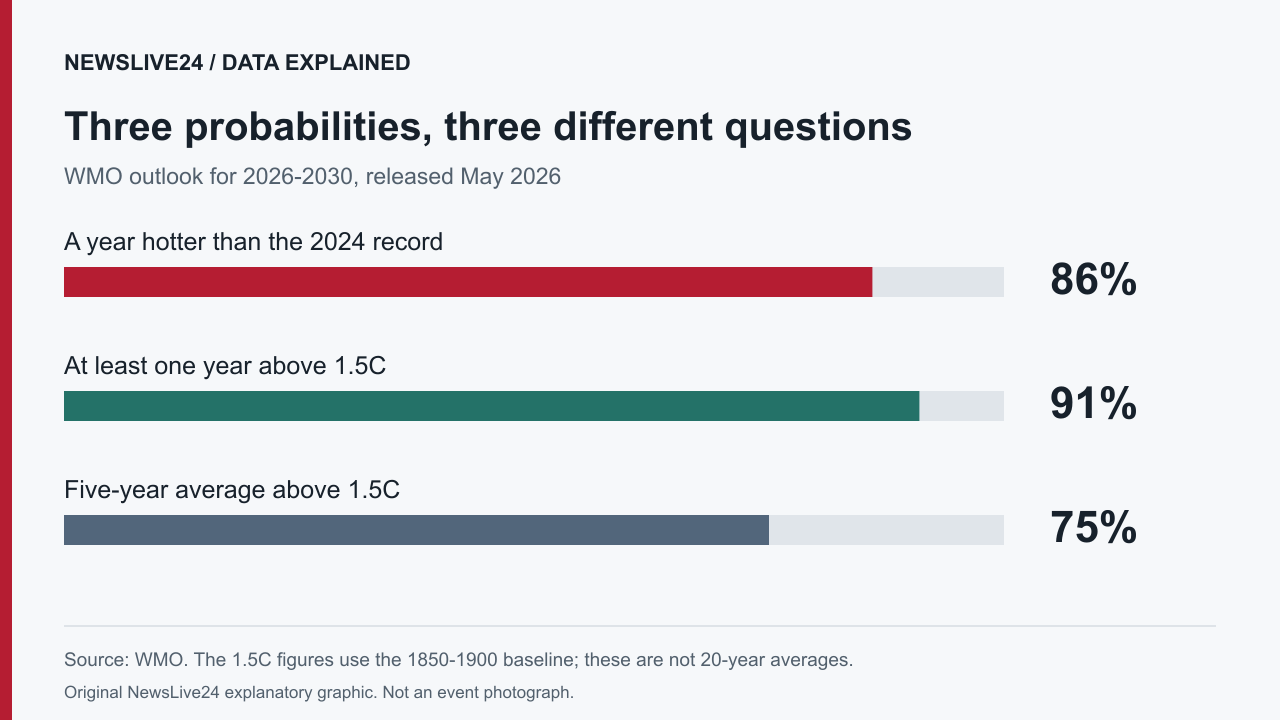
The World Meteorological Organization's May 2026 outlook gives an 86% chance that a year between 2026 and 2030 will overtake 2024 as the hottest recorded. It does not guarantee a record in any particular year.
The probability of at least one year exceeding 1.5C above the 1850-1900 baseline is 91%. The probability that the whole five-year average exceeds it is 75%. Those percentages describe different events, not competing estimates of the same outcome.
An annual crossing is not a long-term threshold crossing. WMO says the Paris goals concern sustained warming, typically assessed over 20 years. One exceptionally hot year cannot alone establish that long-term result.
The Paris Agreement combines a goal of keeping warming well below 2C with efforts to limit it to 1.5C. The UN climate secretariat describes national climate plans as a five-year cycle, with successive commitments intended to become more ambitious. These plans cover both emissions cuts and adaptation to climate impacts.
That distinction matters when interpreting the forecast politically. A temperature outlook does not measure whether a government has delivered its promised emissions reductions. The agreement has a separate transparency framework for countries to report actions and progress, with the global stocktake assessing collective movement towards the goals. Forecasts and implementation reports answer different questions.
Read together, the two sources make the warning more precise: the near-term climate outlook is increasingly hot, while the policy test remains whether countries strengthen and deliver their commitments. Treating a single year's reading as either proof of total failure or a reason to dismiss longer-term warming would miss that distinction.