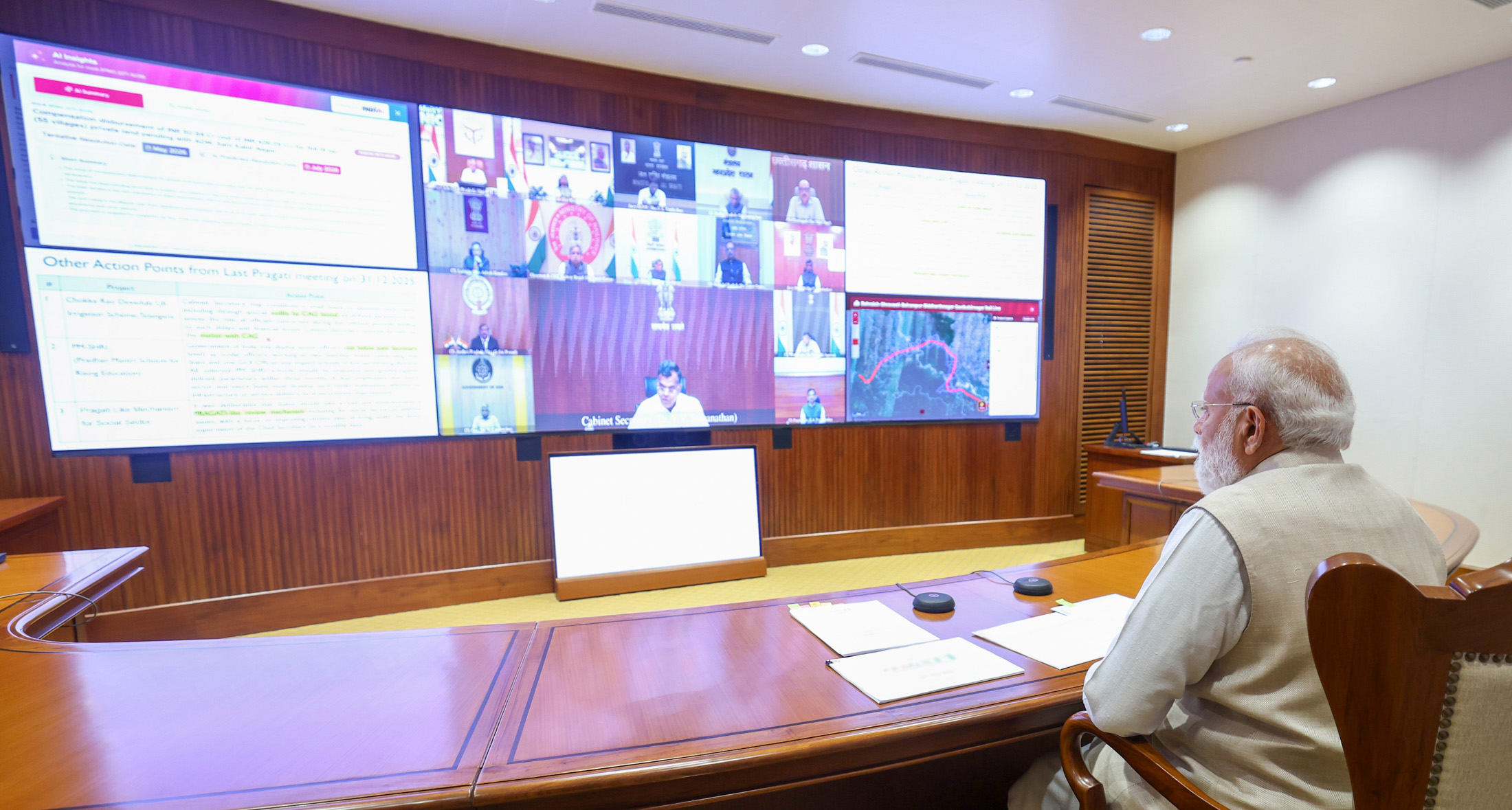
Prime Minister Narendra Modi reviewed seven rail, road and power projects across nine states at the 51st PRAGATI meeting on May 27. The projects involved around Rs 30,000 crore, the Prime Minister's Office said. The agenda also included the Ken-Betwa link and Swachh Bharat Mission-Urban 2.0.
Modi called for urban rooftop solar work focused on residential clusters and public institutions. He also proposed exploring panels alongside and above canals, linking electricity generation with land use and reduced evaporation. On Ken-Betwa, he emphasised cooperation between states, timely clearances and technology-based monitoring, alongside groundwater recharge and efficient irrigation.
States were asked to accelerate waste-processing and GOBARdhan plants. The Cabinet Secretary reported that monthly state reviews of social-sector schemes had begun with sanitation. The Vadhavan discussion sought connections spanning coastal shipping, waterways, freight corridors, railways, highways and airports, treating the development as a transport network rather than only a waterfront project.
The construction baseline comes from the Cabinet's June 2024 approval. Vadhavan Port Project Limited is a joint venture in which Jawaharlal Nehru Port Authority holds 74% and Maharashtra Maritime Board 26%. The approved cost was Rs 76,220 crore, including land acquisition, with terminal and commercial infrastructure involving public-private partnerships.
The approved design includes nine container terminals, each one kilometre long, four multipurpose berths, four liquid-cargo berths, and separate Ro-Ro and Coast Guard berths. It also provides for 1,448 hectares of sea reclamation and a 10.14-kilometre offshore breakwater. These are planned physical components, not assets reported completed at the May review.
The 2024 decision projected annual capacity of 298 million tonnes, including 23.2 million twenty-foot-equivalent container units. It assigned highway connections to the road transport ministry and links with the existing railway and dedicated freight network to the railways ministry. Those separately assigned connections are the concrete institutional background to the latest coordination instructions.