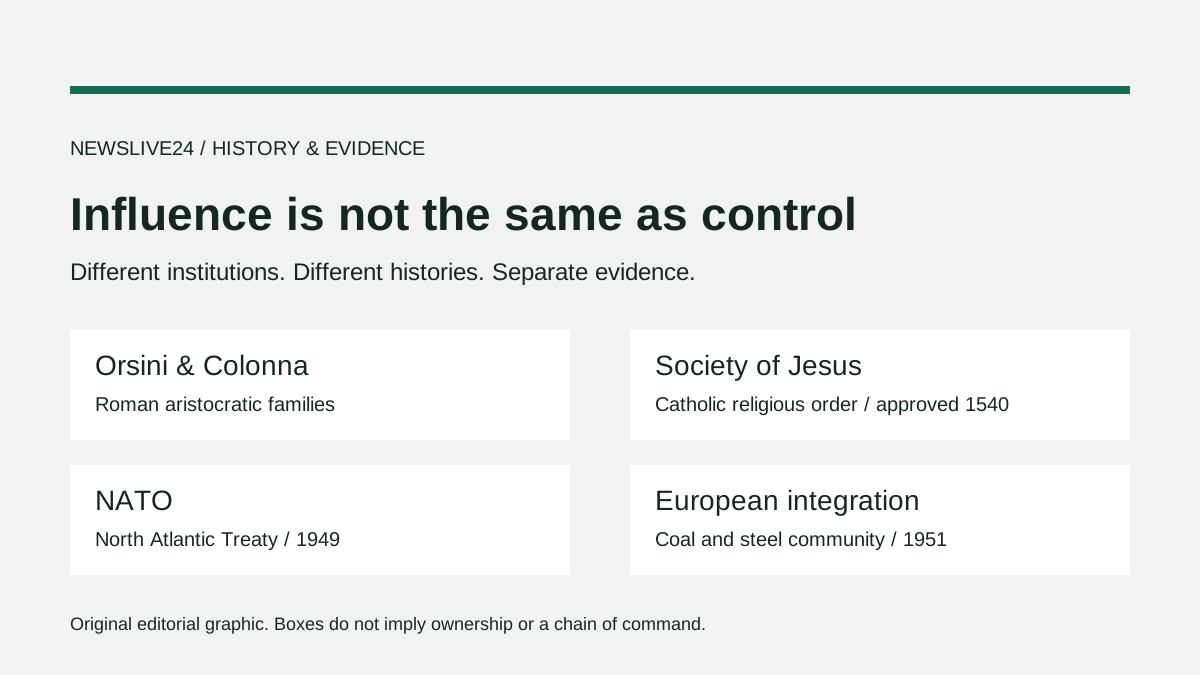
Evidence verdict:The historical sources establish aristocratic influence, not secret family ownership or founding control of the EU and NATO.
Palaces before the conspiracy
The Orsini and Colonna belonged to the aristocratic world surrounding the papacy. Tracy Ehrlich's study of early modern Rome describes papal patronage, marriage alliances and investment in landed estates as routes to family advancement. Those mechanisms are tangible, traceable and more specific than an all-purpose theory of secret government.
Families were not one organisation
Treating every family associated with the papacy as a single permanent command structure erases the differences between kinship, property and public office. A shared social setting is evidence of proximity. Establishing coordinated action requires correspondence, agreements or another record connecting particular people to a particular decision.
The Colonna's heritage illustrates why the setting remains compelling. Their palace preserves a history of papal connections and patronage. Yet a palace, family name or inherited collection cannot establish authority over a twentieth-century treaty. Moving between those subjects without intermediate evidence substitutes atmosphere for an explanation.
The leap to modern alliances
NATO's founding record identifies a treaty signed by twelve states in Washington on 4 April 1949. The Holy See is not among those founding signatories. A claim that an aristocratic family secretly directed that process would need evidence of instructions, negotiations or decision-making beyond the publicly recorded state representatives.
European integration followed another institutional path: the coal and steel community and later the European Economic Community. Calling these institutions a family project does not explain how proposals became treaties. Historical church influence may be a research question, but it cannot stand in for documentation of the alleged mechanism.
What a persuasive investigation needs
The strongest version of this investigation would name an individual, identify an office and connect an authenticated document to a consequential act. A family tree can establish relationships; it cannot, on its own, show that descendants inherited political instructions or exercised the same powers across centuries.
That leaves a story more interesting than either blanket dismissal or sensational certainty. Roman aristocratic power was real enough to study through patronage and property. The additional claim of hidden control over the EU or NATO remains unsupported by the sources examined here, and should be read as a claim rather than a historical finding.
Sources consulted
Tracy L. Ehrlich: Landscape and Identity in Early Modern Rome, Cambridge University Press, sample chapter.