Evidence verdict:The sources reviewed do not establish that the Jesuits secretly founded or control the EU or NATO.
An order is not a dynasty
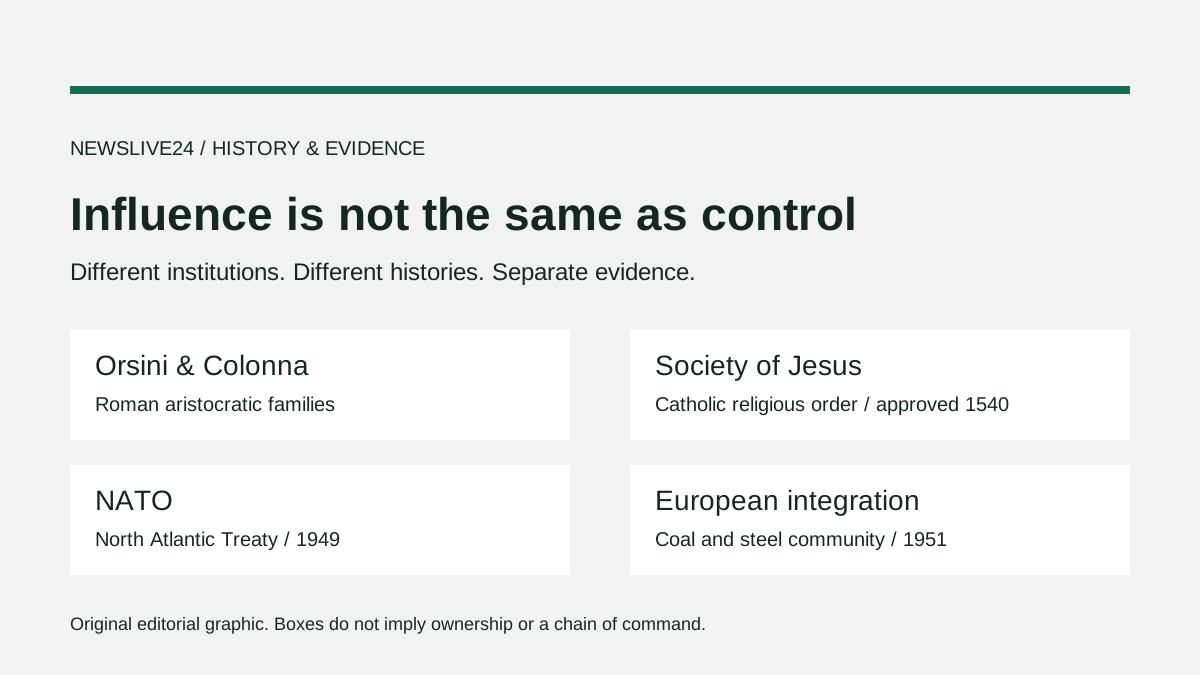
The first distinction changes the whole investigation: the Jesuits are a religious order, not a hereditary Vatican family. Known formally as the Society of Jesus, the order received papal approval in 1540. Its own history traces its foundation to Ignatius of Loyola and his companions.
Education, missionary work and connections across borders make the order an understandable subject of historical inquiry. They do not automatically establish political command. To argue that a school network became the hidden architect of an international organisation requires evidence connecting those two institutions, not simply noticing that both operated internationally.
Faith and European political thought
Catholic belief belongs in an account of some European integration pioneers. European Parliament research describes Robert Schuman as strongly influenced by Christian values. Acknowledging that influence is not the same as concluding that his political programme was an instruction issued by a religious order.
The European Union's historical account places postwar cooperation around initiatives that developed into the coal and steel community in 1951 and the European Economic Community in 1957. These institutions preceded the EU in its later form. Collapsing those stages into one secret founding conceals the proposals and agreements that need examination.
NATO is a different case
NATO's foundation cannot be treated as interchangeable with European economic integration. The alliance arose through the North Atlantic Treaty, signed in 1949 by twelve countries from Europe and North America. Its documented founding parties were states, not the Society of Jesus or the Holy See.
An argument about indirect religious influence could still be investigated, but it would have to identify a particular actor and decision. Religious affiliation alone does not demonstrate that a statesman acted under orders, just as studying at an institution does not establish that it controlled every later choice.
Follow documents rather than symbols
A useful evidence test separates three propositions: someone held a belief, someone maintained a relationship, and someone exercised command. The first two may be documented without establishing the third. A persuasive hidden-control claim needs a reliable bridge between them, including the content and consequences of any alleged instruction.
This is why the historical record should remain central to the reading experience. The Jesuits' institutional history and Christian contributions to European political thought are legitimate subjects. The larger assertion of secret founding control is not established by the sources consulted, and a dramatic narrative cannot supply the missing evidence.