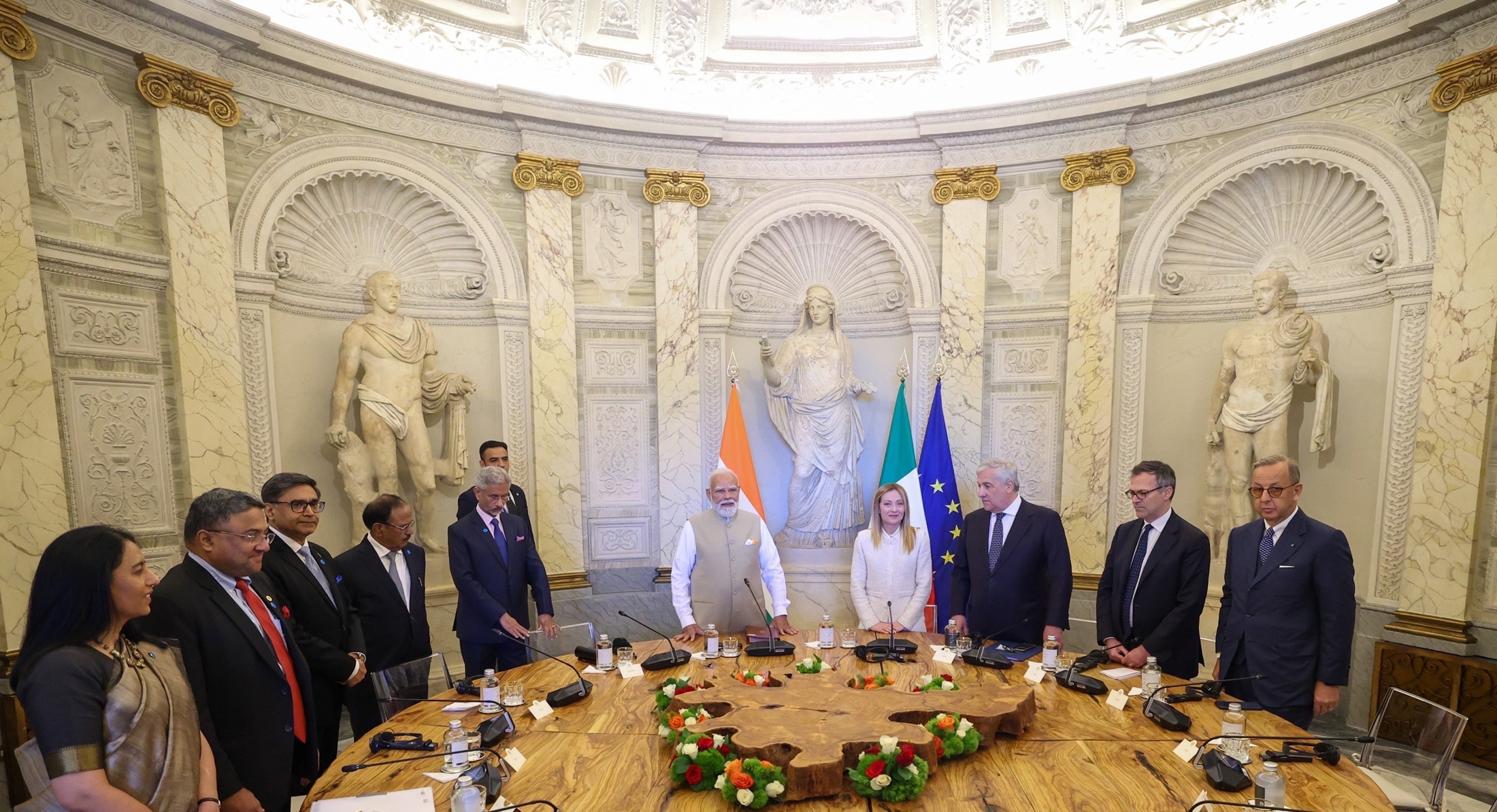
India and Italy elevated their relationship to a Special Strategic Partnership at talks between Narendra Modi and Giorgia Meloni in Rome on May 20. The leaders agreed to meet annually and create a foreign-minister-level mechanism to review their 2025-2029 action plan, according to the Prime Minister's Office.
Meloni put current bilateral trade at EUR 14 billion and the 2029 target at EUR 20 billion in her press statement. She linked the target to the India-EU trade agreement and cooperation between India's digital economy and Italy's manufacturing sector. Moving between those rounded values would require an increase of about 43 percent over three years.
The Indian account said a defence industrial roadmap would support joint design, development and production. The leaders also discussed cooperation in semiconductors, critical minerals and artificial intelligence, alongside collaboration between the Indian and Italian space agencies. These commitments broaden the industrial agenda beyond purchasing finished equipment to work involving research institutions, technology development and manufacturers.
Meloni described the proposed INNOVIT India centre in New Delhi as a meeting point for businesses, startups, universities and researchers. She said the two countries had held three business forums during the preceding year. The leaders were also to meet business representatives after the press statements to discuss industrial cooperation and direct investment.
Mobility and cultural exchanges formed another part of the package. The PMO account recorded cooperation on recruiting nurses from India, facilitating exchanges among students and researchers, and developing the National Maritime Heritage Complex at Lothal. The two governments designated 2027 for a bilateral year of culture and tourism, adding education and people-to-people exchanges to the commercial programme.
Both leaders reaffirmed support for the India-Middle East-Europe Economic Corridor. Meloni connected the project to Italy's Mediterranean location and India's position in the Indo-Pacific, while also stressing freedom of navigation amid the Iran crisis. The combined agenda links industrial collaboration to the movement of goods, knowledge and skilled people. Its immediate commitments include formal review arrangements and sectoral cooperation, with the 2029 trade goal providing a separate commercial benchmark.