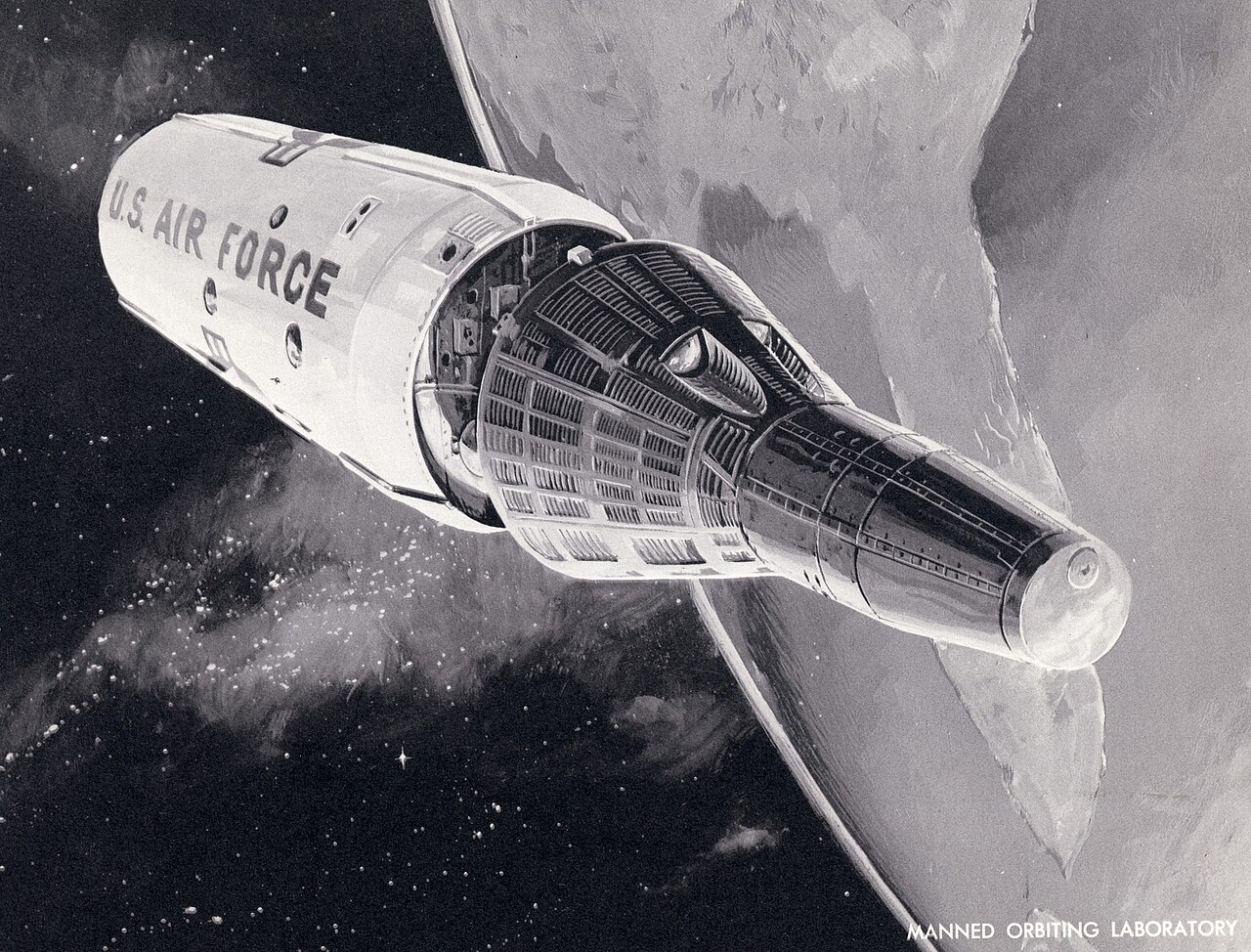
Military secrecy is part of space history, but a secret mission and a secretly accomplished mission are not the same thing. The Manned Orbiting Laboratory, or MOL, provides a documented example. Its proposed reconnaissance role was classified; its development left records, hardware and a cancellation. Those distinctions are lost when genuine military projects are presented as proof of hidden interplanetary fleets.
An Air Force information plan dated January 10, 1966, now available through the National Reconnaissance Office, collected approved public material about MOL. An attached August 1965 announcement named Douglas as the spacecraft contractor and General Electric for experiments. It described future flights, including two-person crews, rather than reporting that a crewed station was already operating.
The plan also contained prepared answers for public questions. One defended the usefulness of people in orbit by comparing human judgement with the limitations of automation at that time. This is a revealing historical assumption: planners were considering what astronauts could contribute to military work, not documenting capabilities beyond contemporary spacecraft. An official forecast remains a forecast even when found inside a declassified file.
NASA's historical account identifies the central classified payload as a photographic reconnaissance system called Dorian, with the designation KH-10. Crews were intended to work in low Earth orbit and return in modified Gemini capsules. The target was imagery of terrestrial adversaries. Neither that mission nor its specified orbit describes travel to another planet.
NASA also records what actually flew: an uncrewed test on November 3, 1966, carrying a MOL mockup and a Gemini-B capsule. That test demonstrated the capsule's heat-shield hatch during re-entry. It did not establish a functioning crewed reconnaissance station. The programme was cancelled on June 10, 1969, amid budget pressure and improvements in uncrewed surveillance.
Reading the planning file beside the later history prevents two opposite mistakes. The programme should not be dismissed as imaginary merely because its reconnaissance purpose was concealed. But proposed crews and scheduled launches should not be promoted into completed operations. MOL is evidence of a particular Cold War project with technological and financial limits; it supplies no evidentiary bridge to alien agreements, off-world colonies or an undisclosed interplanetary fleet.