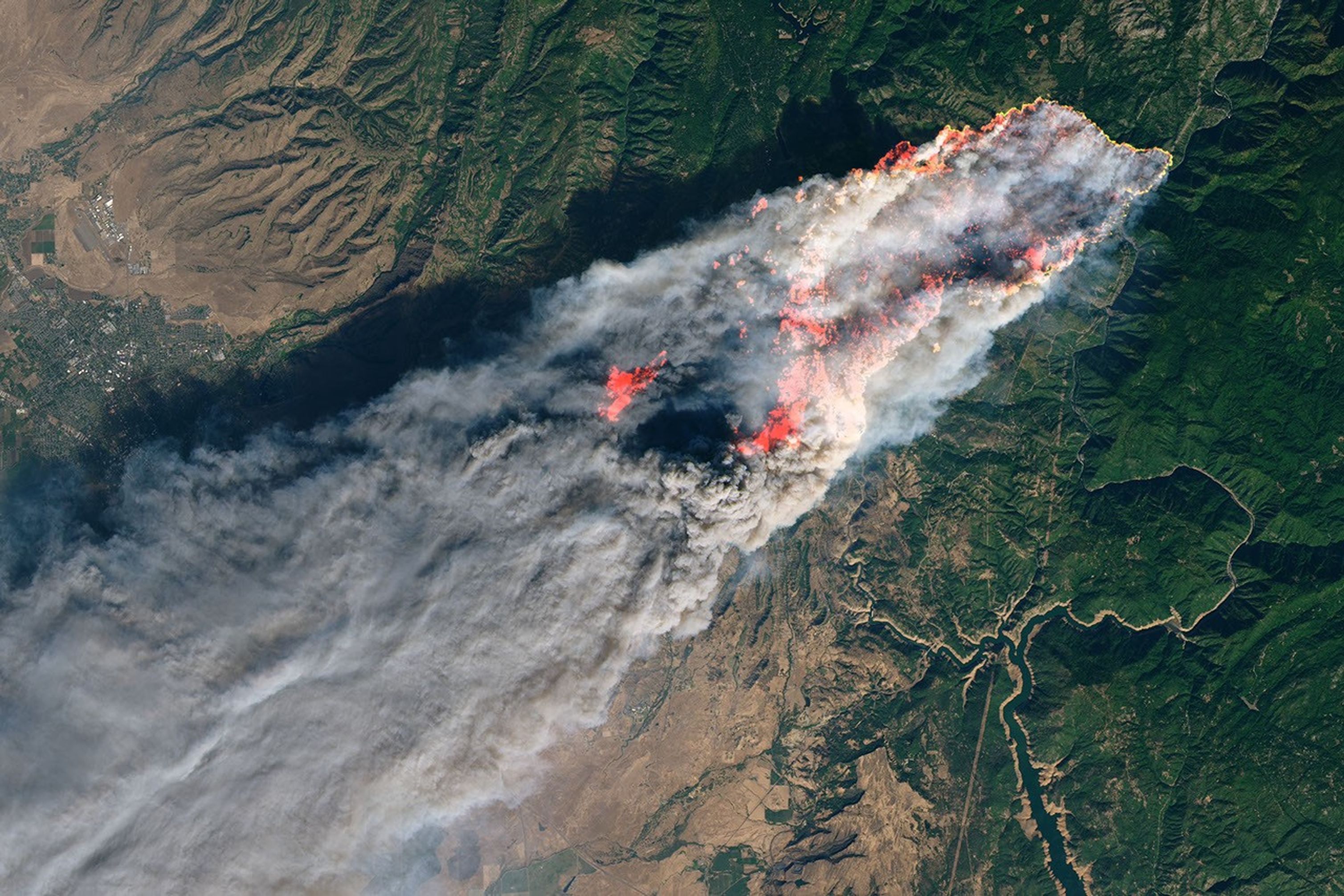
The 2018 Camp Fire offers a specific test of claims that California fires were ignited by an orbital weapon. Its documented cause concerns electrical infrastructure near Pulga, not a demonstrated beam from space. Different California fires have different ignition histories; the Camp Fire's findings concern this particular disaster.
In its May 15, 2019 announcement, CAL FIRE attributed the fire that began on November 8, 2018 to PG&E transmission lines. It identified a second ignition involving vegetation and distribution lines near Concow Road and Rim Road; that fire was overtaken by the earlier one.
The same announcement distinguished ignition from spread. Dry vegetation, strong winds, low humidity and warm conditions helped the fire advance rapidly. This is an important causal separation: the thing that starts a fire and the conditions that turn it into a catastrophe need not be the same.
The California Public Utilities Commission later oversaw a root-cause analysis of the 2017 fires and the Camp Fire. Its public process page records a final Envista report in July 2022 and corrective-action proceedings culminating in a November 2023 resolution. That process examines prevention and organisational responsibility beyond the immediate ignition.
Neither the existence of that regulatory inquiry nor the scale of destruction supplies the missing evidence for an orbital weapon. Such an allegation would have to account for the investigated ignition sites and establish a mechanism connecting a particular device to this event. CAL FIRE's findings instead identify terrestrial electrical causes.
For the Camp Fire, the practical questions follow from those findings: how electrical equipment ignited vegetation, why the fire spread so rapidly and what changes could prevent another infrastructure failure. An orbital-weapon story offers no evidence that displaces that chain of causes.