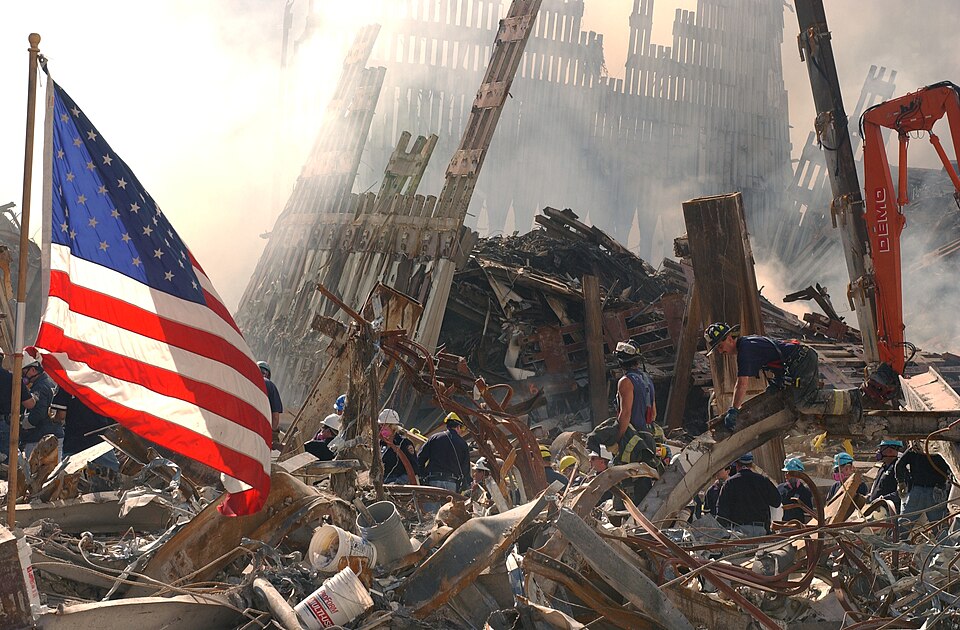
The claim that the World Trade Center was demolished with planted explosives is not supported by NIST's investigations. But explaining that conclusion requires separating the two aircraft-struck towers from WTC 7 and stating what the investigators actually tested. Saying that investigators proved every possible alternative impossible would go beyond their published work.
For the towers on September 11, 2001, NIST describes a combination of damaged columns, displaced fireproofing and fires across multiple floors. Heated floors sagged and pulled on exterior columns, contributing to their failure. The explanation does not require steel to turn into liquid: a structural member can lose the strength needed to carry its load while remaining solid.
There is an important limit to the forensic claim. NIST explicitly says it did not test the recovered tower steel for explosive or thermite residues. Its rejection of controlled demolition instead rests on the collapse sequence and the absence of corroborating blast evidence. The lack of a residue test must not be rewritten as a negative laboratory result.
WTC 7 requires a separate account. NIST reports that debris from the North Tower ignited fires and damaged water supplies prevented sprinklers on lower floors from operating. Its probable sequence begins with heat-driven expansion in floor framing, displacement of a girder near Column 79 and cascading floor failures that left the column insufficiently supported. Interior failures preceded the collapse of the exterior.
NIST also acknowledges uncertainty in modelling the later stages of WTC 7's collapse, when breaking and falling components interacted. That qualification concerns the precision of the simulation; it is not affirmative evidence that explosives were present. The relevant comparison is between a documented structural mechanism and evidence for a competing mechanism, not between a complex building failure and an expectation that every visible movement must look identical to an animation.