HAARP's history includes military research, but that history is not a demonstration that the installation can steer storms. The High-frequency Active Auroral Research Program investigates the electrically charged upper atmosphere. Confusing that region with the air in which rain and most clouds form is central to the weather-control claim.
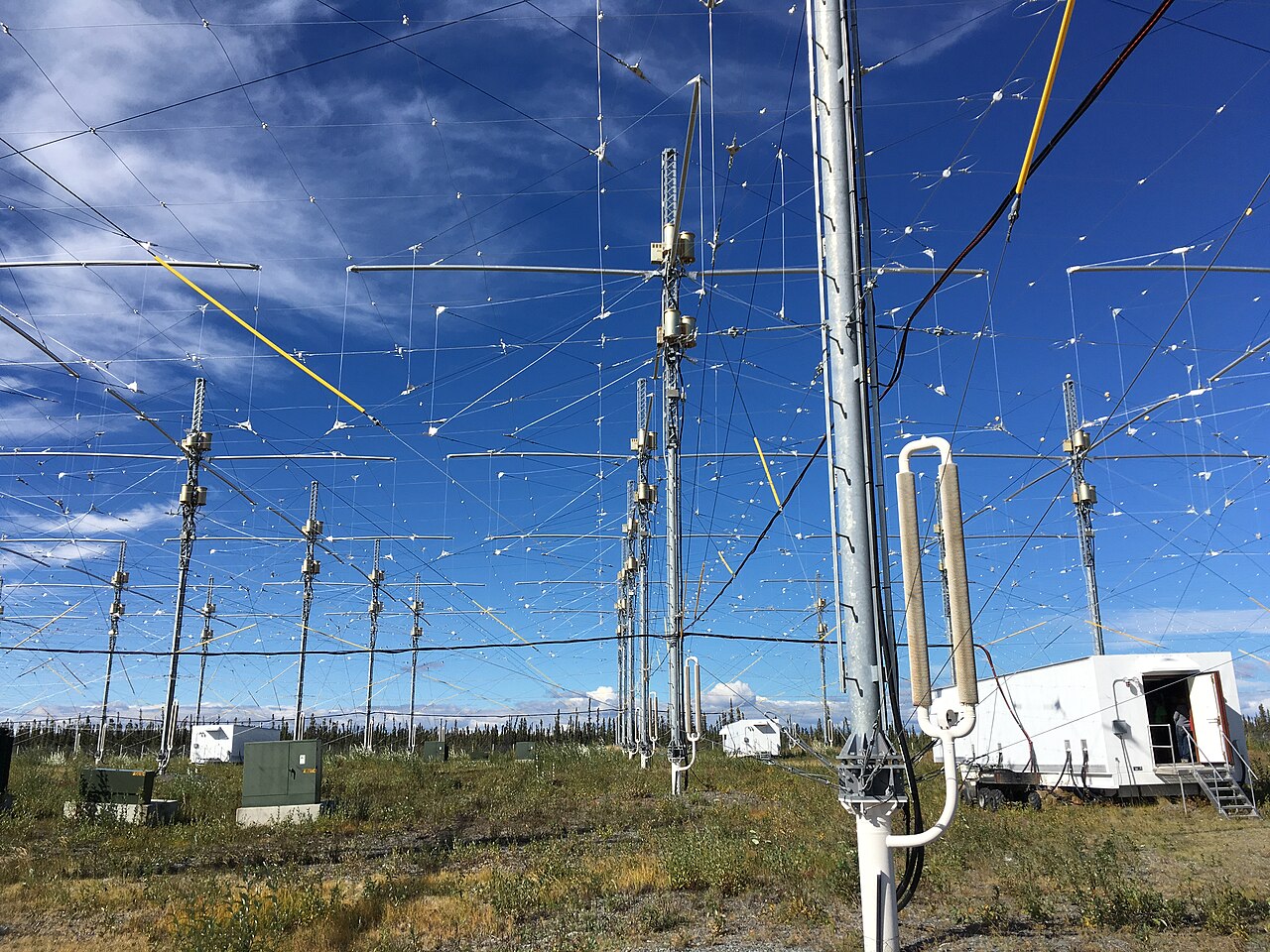
The University of Alaska Fairbanks describes a transmitter that heats electrons in small regions of the ionosphere, allowing researchers to create and measure disturbances rather than wait for a natural event. Its FAQ places the beginning of that region roughly 60 to 80 kilometres above the ground. The experiments concern radio propagation and related physical processes, not the movement of a storm system across a continent.
NOAA's atmospheric guide explains why altitude matters. Almost all weather occurs in the troposphere, the lowest layer. Its upper boundary varies with latitude: it is much higher around the equator than near the poles. The atmosphere is therefore not one uniform chamber in which heating anywhere produces the same effect everywhere.
Above the troposphere lies the stratosphere, containing little water vapour and a temperature pattern that suppresses convection. Higher still, the thermosphere contains extremely thin gas. NOAA notes that high molecular temperatures there do not translate into the familiar heating effect on a person's skin because so few molecules are present. A temperature change in rarefied upper air should not be equated with heating the dense, moist air near the surface.
HAARP's operator says its transmitting frequencies are not absorbed in the troposphere or stratosphere, so they do not provide the proposed route to weather control. EPA separately records that responsibility for the equipment and facilities passed from military management to the university in 2015 and that the programme is not classified.
These records explain both the genuine defence connection and the physical mismatch in the storm allegation. They do not authenticate claims of earthquake generation or control over human thought. Neither claim follows from the existence of a powerful radio transmitter. This review establishes the research setting and atmospheric distinction; it does not pretend to investigate an unnamed disaster or supply a medical finding about a purported victim.