Real intelligence abuses do not need an all-explaining deep-state theory to become serious. The US Senate's Church Committee investigated particular programmes, institutions and failures of oversight in 1975 and 1976. Its history provides a more demanding account of concealed power: misconduct can be documented without assuming that every official, agency and elected leader belongs to a single hidden command.
The FBI's own institutional history acknowledges that COINTELPRO began in 1956 and expanded beyond its initial Communist Party target. It describes infiltration, the cultivation of internal discord and efforts to discredit groups even where evidence of unlawful activity was slight or absent. Those admissions concern interference with political organisation, not merely passive collection of information.
According to that account, the public learned about the programme after documents taken from the FBI's Media, Pennsylvania, office in 1971 reached the press and Congress. J. Edgar Hoover formally ended COINTELPRO that April. The agency also acknowledges criticism over First Amendment rights. This is the institution describing its own conduct retrospectively, a perspective that should be read alongside external scrutiny.
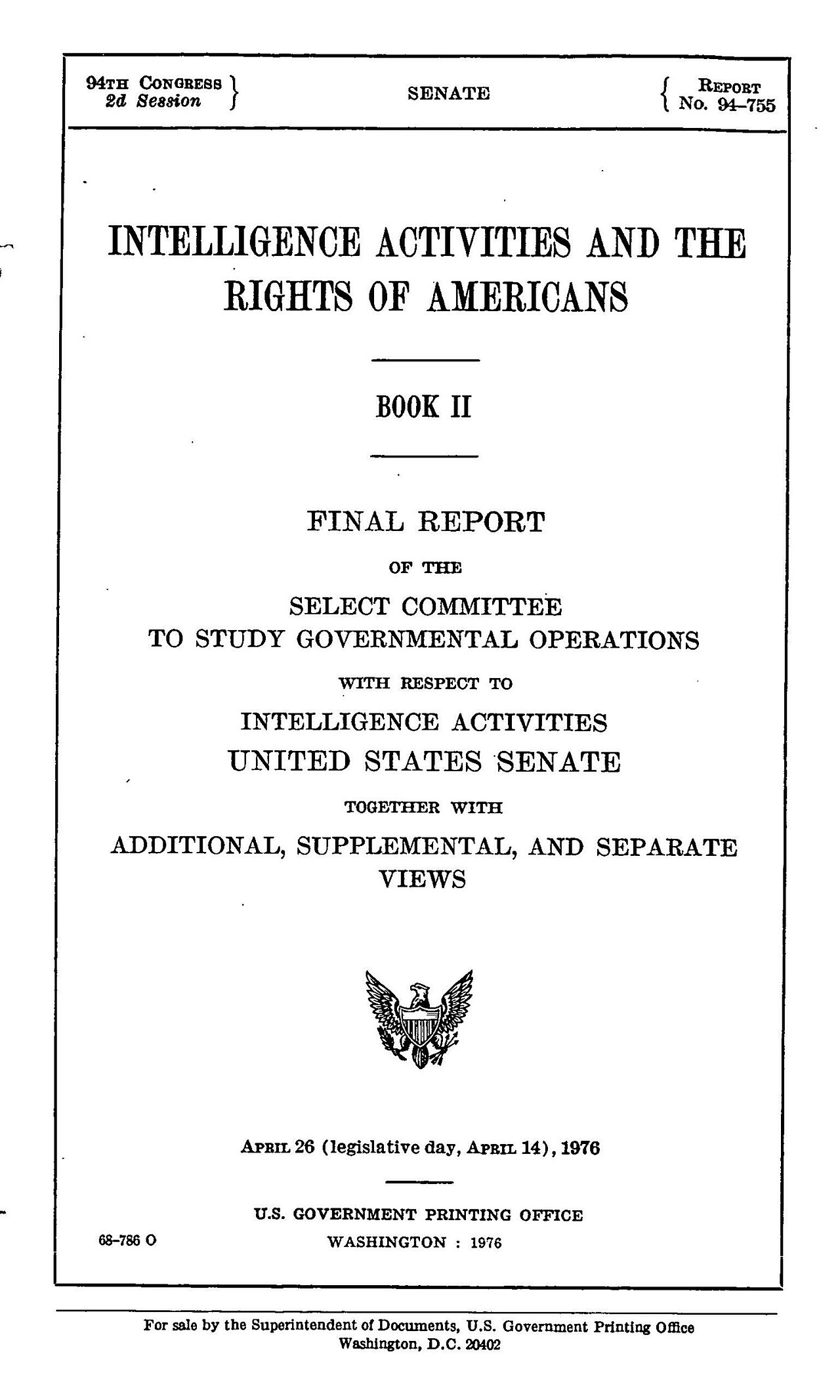
The Senate Historical Office records that the Church inquiry examined the CIA, FBI, National Security Agency and Internal Revenue Service. Its investigators traced domestic disruption and communications-surveillance programmes. The final report, issued on April 29, 1976, treated the abuses as a problem spanning administrations, rather than the work of one political party or a single individual.
The inquiry led to institutional changes, including the Senate's establishment of a permanent intelligence oversight committee in 1976. Its account emphasises the failure of checks and balances and the need to bring intelligence activity under constitutional controls. Reform was a response to documented wrongdoing, not evidence that the wrongdoing had been harmless or that future oversight could never fail.
This history cuts against two shortcuts. Dismissing every allegation of secret misconduct would ignore an established record of abuse. Treating that record as automatic proof of any later allegation would ignore the investigations that made the earlier case credible. COINTELPRO has a name, a chronology, identified methods and an institutional paper trail. A claim about a present-day covert operation needs its own connection between decisions and conduct; resemblance to a past scandal cannot supply that connection by itself.