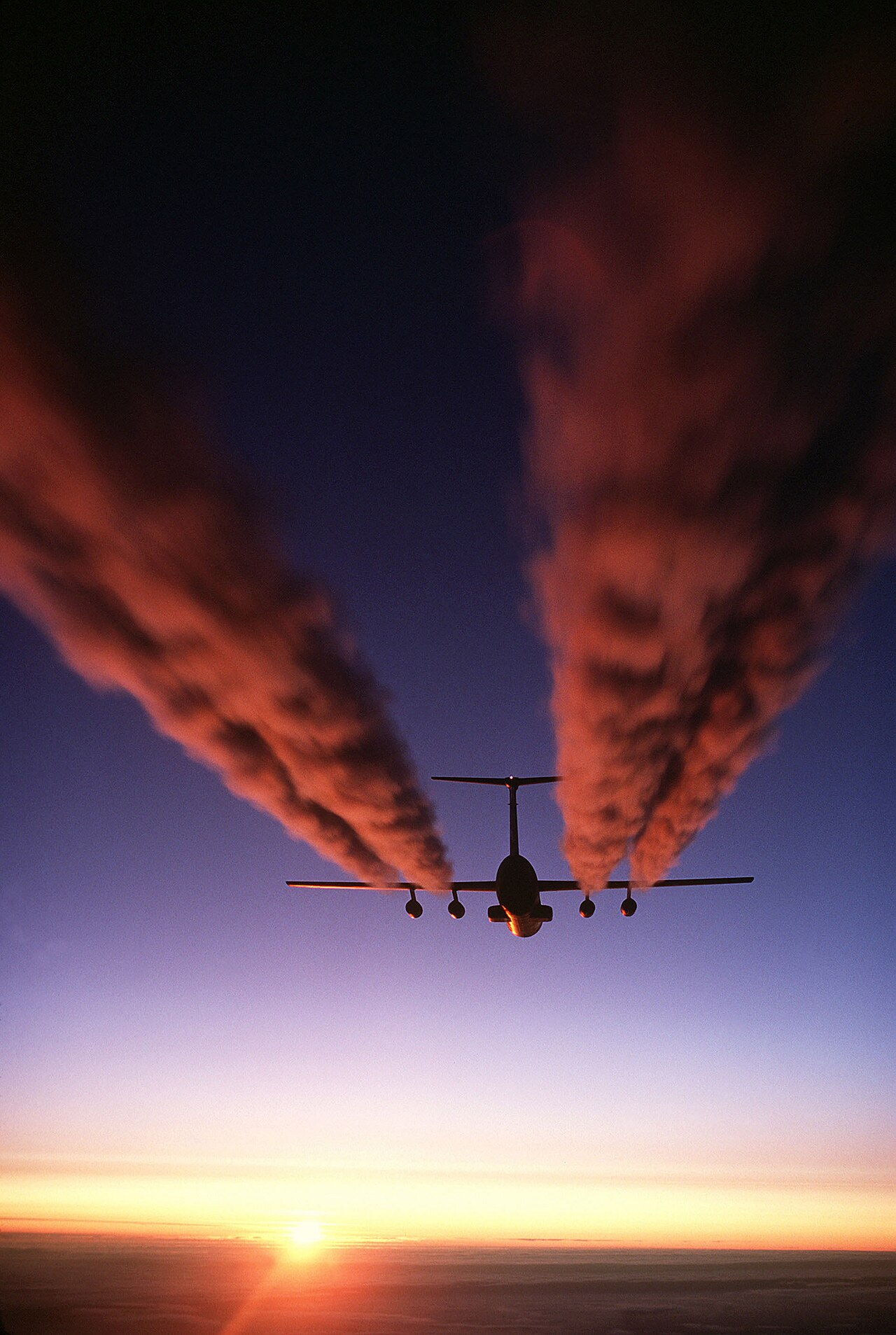
A white trail that remains after an aircraft disappears is not, by itself, evidence of a secret spraying operation. Contrails are clouds produced under particular atmospheric conditions. The important distinction is between the visible ice crystals and the aircraft's wider exhaust emissions: explaining the cloud does not mean declaring aviation pollution harmless.
The US National Weather Service explains that engines produce water during combustion. Their hot, moist exhaust mixes with much colder surrounding air, allowing condensation to occur. Humidity helps determine how long the resulting trail survives. Conditions experienced by someone looking up from the ground therefore cannot establish the moisture conditions around an aircraft thousands of metres above them.
The Environmental Protection Agency describes the next step: droplets freeze into ice crystals. In sufficiently humid air, trails can survive for more than a day and spread into cirrus clouds. A long-lived trail is consequently compatible with ordinary cloud formation. Its duration alone does not identify an extra substance or demonstrate an intentional release.
Nor does a broken or intersecting pattern establish a spraying schedule. The Federal Aviation Administration explains that a trail can begin or stop when an aircraft crosses the boundary of a moist air region. Flight paths and winds shape the pattern, while older trails drift away from where they formed. Matching a visible trail to the aircraft currently overhead can therefore be misleading.
Intentional aerial spraying does exist. EPA identifies agricultural treatments and firefighting as documented examples. Those operations should not be confused with the claim that routine high-altitude jet trails reveal a concealed programme. Recognising a real, regulated activity does not supply evidence that a different aircraft is carrying out the alleged one.
There is also a genuine research question about persistent contrails. FAA describes work on weather forecasting, fuels, engine technology and route choices to reduce their effects. That programme concerns aviation-induced clouds and their environmental impact, not confirmation of chemtrails. The scientifically useful distinction is between measuring emissions and cloud formation, which researchers can investigate, and inferring a covert purpose from a photograph, which the photograph cannot establish.