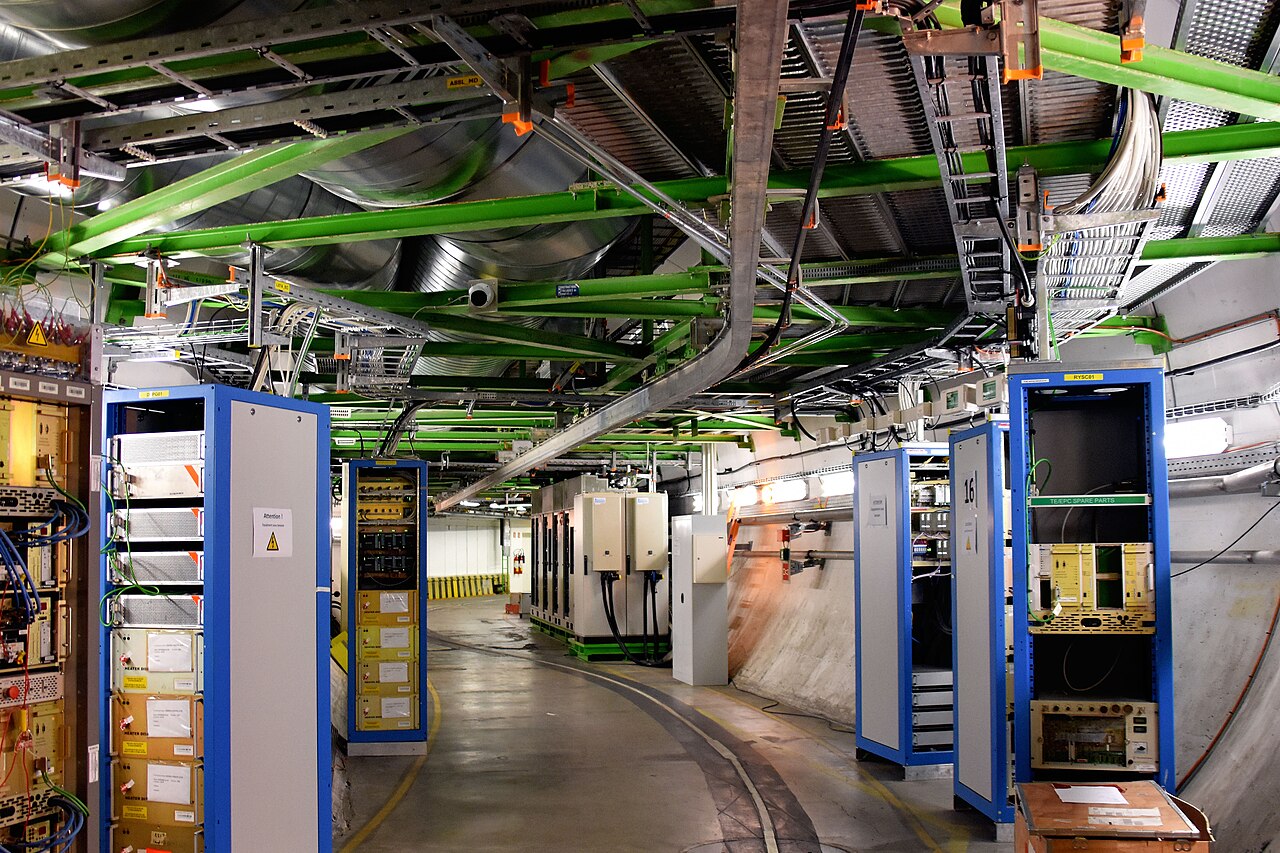
The Large Hadron Collider investigates particles and unresolved questions about their interactions. Its safety case does not simply ignore unfamiliar physics: a 2008 assessment considered hypothetical microscopic black holes and other proposed hazards, rather than restricting itself to already-known particles.
CERN distinguishes ordinary expectations from speculative models that permit microscopic black holes. Such objects are expected to decay rapidly. This is a conditional prediction, not a report that an astronomical black hole has been created: the hypothetical status is essential.
The assessment by John Ellis and colleagues adds a check that is independent of constructing the same machine twice. Cosmic rays have produced collisions at energies beyond those available at the collider for billions of years. The continuing existence of Earth and other astronomical bodies constrains claims that comparable collisions would initiate an unstoppable destructive process.
The authors did not stop at the expected decay through Hawking radiation. They also considered stable microscopic black holes and the restrictions that astronomical observations place on their ability to accumulate matter. This is important because simply questioning one theoretical decay mechanism does not dispose of the rest of the safety analysis. A proposed hazard must also be compatible with the cosmic-ray history of matter outside the laboratory.
CERN's public account says the safety report was reviewed and endorsed by the American Physical Society, Britain's Institute of Physics and the German Physical Society. That is additional institutional scrutiny, although the substantive explanation remains the comparison between the proposed process and what nature already does.
Claims about supernatural portals are a different proposition. Neither the accelerator description nor the safety assessment reports such a discovery. A photograph of equipment or a symbolic interpretation of CERN imagery is not a measurement of an interdimensional passage. Uncertainty in fundamental physics remains, but it is not evidence of a supernatural passage. The catastrophic scenarios considered in the safety assessment were tested against physical observations; portal imagery supplies no comparable measurement.