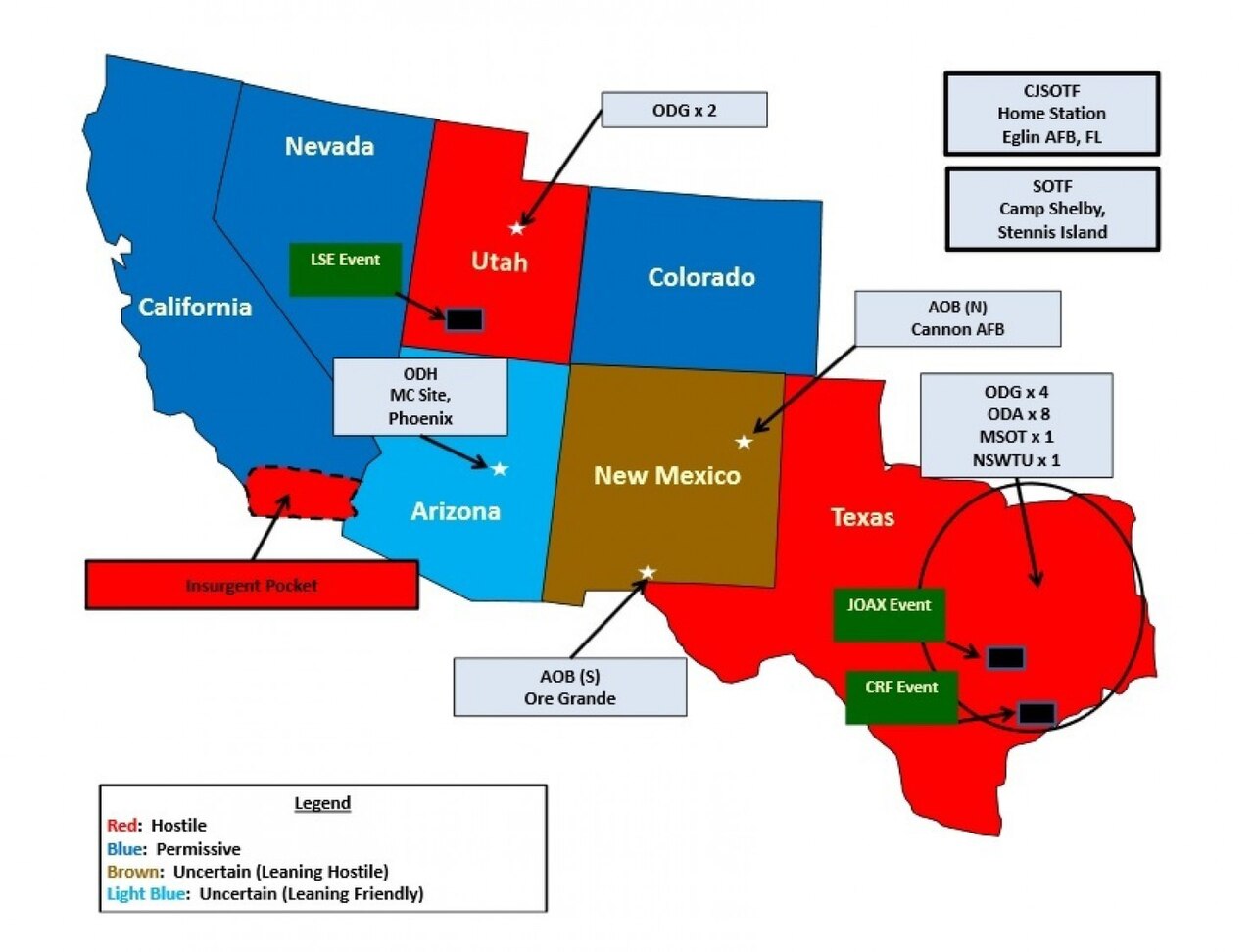
The black-helicopter narrative often turns visible military activity into a claim about an invisible mission. Jade Helm 15 offers a specific episode to examine. In 2015, a real training exercise became the subject of allegations that federal troops would disarm or round up Americans. The exercise's existence was documented; the asserted domestic takeover was a separate, unsupported claim.
An Army Special Operations Command fact sheet scheduled the training for July 15 to September 15, 2015. It described practice for overseas missions, including movement of personnel and equipment, aerial resupply and recovery operations. It also acknowledged night activity. Aircraft movement and unusual hours were therefore anticipated features of the published plan, not discoveries that independently established a covert purpose.
The fact sheet said activities on public and private land had been coordinated with authorities and participating owners. It explicitly denied a domestic law-enforcement role or martial-law purpose. Those statements describe the Army's announced mission and safeguards; they should not be mistaken for an independent inspection of every event that occurred.
Texas Governor Greg Abbott issued a separate directive on April 28, asking the Texas State Guard to monitor the operation and provide updates. His office framed the task around public safety, civil liberties and property rights. An instruction to monitor an exercise is evidence of official concern and a reporting arrangement, not a finding that the feared takeover had been uncovered.
Contemporaneous reporting adds a local observation. On July 15, Texas Tribune reporter Morgan Smith visited the Bastrop area and described a quieter opening than the dramatic predictions. The report recorded gunfire audible near Camp Swift and interviewed residents who had seen little military activity. That account is geographically and temporally limited: it describes what was observed locally on the opening day, not a nationwide operational audit.
Together, these records explain why the distinction between activity and intent matters. Training can generate noise, aircraft movements and legitimate questions about access to land. Those concerns have identifiable officials and arrangements attached to them. Calling the same activity a takeover adds a claim about purpose that a helicopter photograph cannot establish. Jade Helm provides a documented historical comparison, not a blanket explanation for every unidentified aircraft sighting.