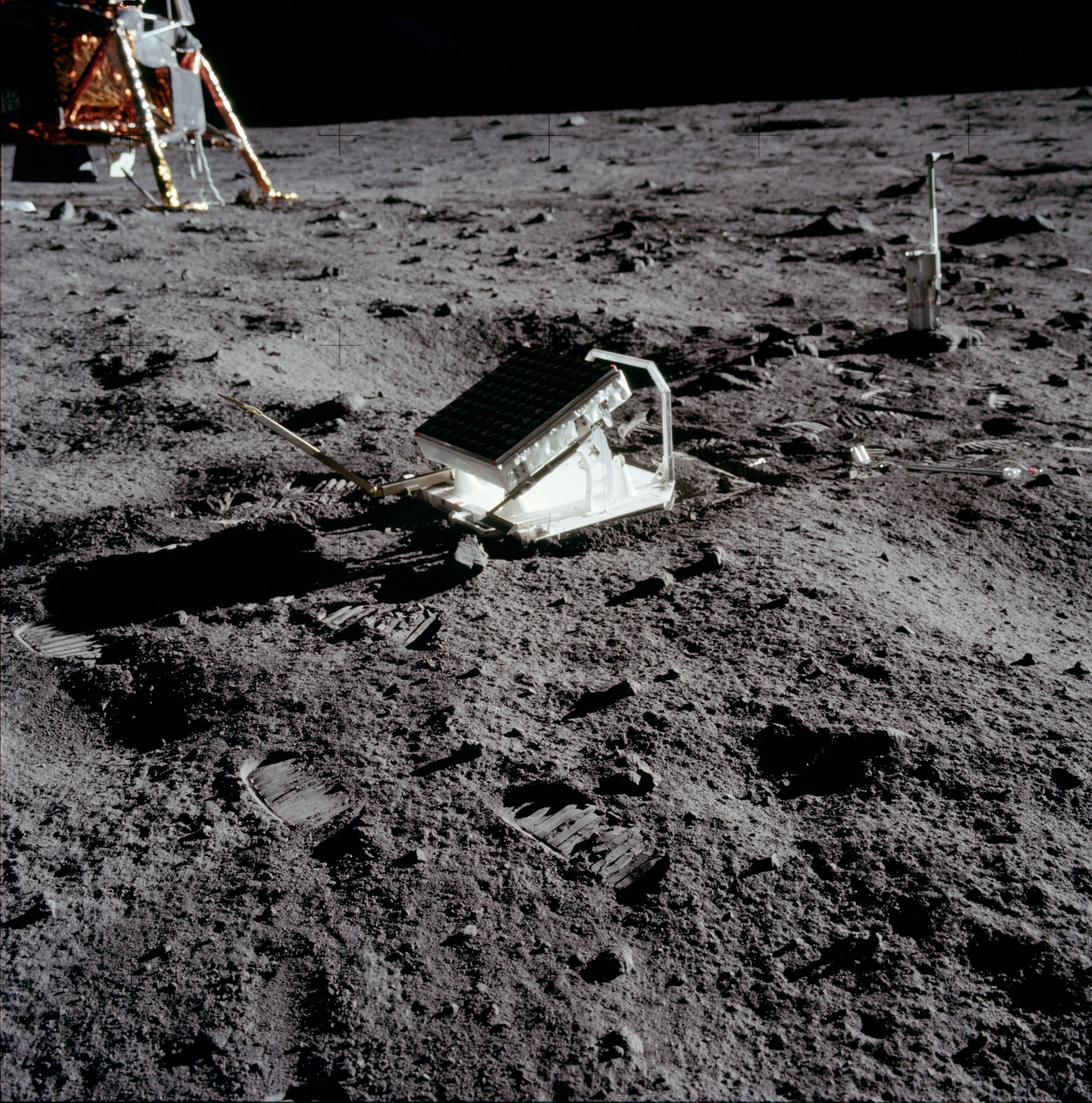
Apollo's record is not confined to television footage. NASA's Apollo 11 history describes a mission that launched on July 16, 1969, landed Neil Armstrong and Buzz Aldrin on the Moon while Michael Collins remained in orbit, and deployed scientific equipment as well as collecting samples. Those activities provide a broader historical account than arguments about an isolated photograph.
One instrument was a laser-ranging reflector. Researchers time the return of light to measure Earth-Moon distance, obtaining fresh observations rather than repeatedly interpreting an old picture.
A reflected pulse alone does not prove delivery by a person. NASA's 2020 account describes both Apollo arrays and reflectors carried by robotic Soviet Lunokhod missions. Hardware measurements and the historical evidence for its delivery answer different questions.
The researchers also investigated weak returns from older arrays, including whether dust contributed, using an orbital reflector for comparison. An unresolved question about instrument performance does not mean that the instrument or experiment was fictional.
Apollo 11's mission narrative separately describes Armstrong and Aldrin's surface work, return to lunar orbit and reunion with Collins. The photographic record belongs within that sequence of operations and experiments. A claim that everything was filmed on Earth would need to address this wider record, not merely identify a picture that looks unfamiliar.
The sources examined support the documented lunar mission and subsequent ranging research; they do not establish a filmed-on-Earth alternative. This account does not claim to have reanalysed every shadow, flag movement or tracking archive. Its narrower point is that judging Apollo solely from the appearance of selected images excludes evidence that can be investigated through physical measurement.