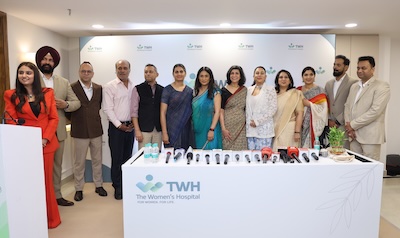
Delhi has welcomed its first dedicated multispecialty hospital exclusively focused on women’s healthcare with the launch of The Women’s Hospital (TWH) at Nehru Enclave, Outer Ring Road.
The hospital, founded by Anika Parashar and her team, received a USD 5 million investment from various investors.
Ft. The facility integrates clinical care, preventive healthcare, diagnostics, wellness, aesthetics, and life-stage-based specialty clinics under one roof.
The hospital conceptualizes care for women across all age groups and health journeys, from adolescent menstrual health and reproductive care to fertility, pregnancy, postpartum recovery, menopause, metabolic disorders, cancer care, mental health, and ageing-related wellness.
The launch ceremony was attended by chief guests Jyotsana Sharma, Saroj Singh, and Mala Baijal.
India’s women’s healthcare challenges continue to remain significant, with millions of women facing gaps in preventive and specialized care.
Speaking on the launch, Anika Parashar, Founder & CEO, The Women’s Hospital said, “TWH comes from a gap I have seen in over 25 years of working closely with women, families, doctors and healthcare teams.
Women are often expected to care for everyone else, but when it comes to their own health, they are left to navigate fragmented systems, repeat their stories, delay care, or feel unheard.
We want to create a healthcare home where a girl, a mother, a working woman, a woman in menopause, or an elderly woman can access specialised, preventive and holistic care without judgment.”.
She added, “Every detail, from our clinical blueprint and life-stage clinics to the doctors, privacy, air quality and patient experience, has been designed to make women feel safer, supported and more in control of their health.”.
The health significance of the development depends on confirmed data, public advisories and the response of medical or public-health authorities. Any claim involving risk to patients, medicines, outbreaks or hospital systems should be read alongside official guidance.
For India and other large public systems, such updates are useful when they connect global or national figures with practical questions of access, affordability, prevention, district readiness and communication to vulnerable groups.