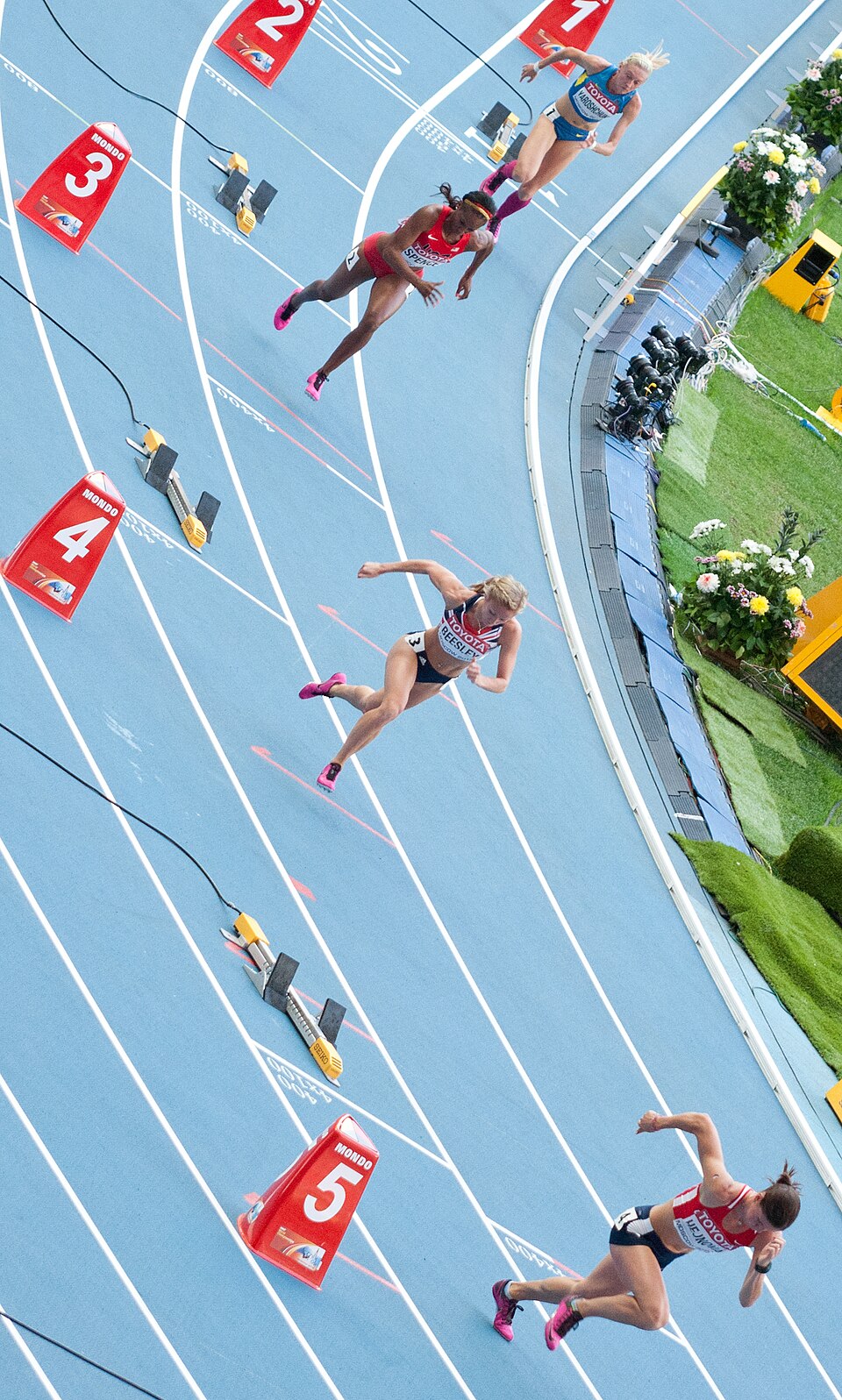
Vithya Ramraj ran 54.75 seconds for bronze in the women's 400 metres hurdles at Nagoya on September 28, 2026. World Athletics lists the performance as an Indian national record at Municipal Mizuho Stadium. The medal matched her placing at the previous Asian Games, but the time tells a substantially different story about progress between the two competitions and the level required to reach the podium.
The federation's Hangzhou results record 55.42 in her October 2023 heat and 55.68 in the final. Comparing like with like, the Nagoya final was 0.93 seconds faster than her earlier medal-winning final, an improvement of about 1.7 per cent. Against the faster Hangzhou heat, the reduction was 0.67 seconds. Keeping those comparisons separate gives two useful measures: improvement on her earlier fastest performance and improvement in the medal race itself.
In Nagoya, Mariam Kareem won in 54.31 and Adelina Zems took silver in 54.58, according to World Athletics' Games report. Ramraj was therefore 0.17 seconds behind silver and 0.44 behind gold. At Hangzhou, Kemi Adekoya won in 54.45, putting Ramraj's 55.68 final 1.23 seconds behind the winner. Her gap to the winning time narrowed by 0.79 seconds across the two finals, even though her finishing position remained third.
These calculations suggest why medal totals alone are a blunt way to track an athlete's development. A placing depends on the other finalists as well as the athlete's own race; time supplies an additional benchmark that can be compared across editions. Ramraj improved both her absolute final time and her distance in seconds from the champion. The combination gives coaches and followers a more informative assessment than bronze viewed in isolation, while leaving race tactics and hurdle execution to a separate technical analysis.