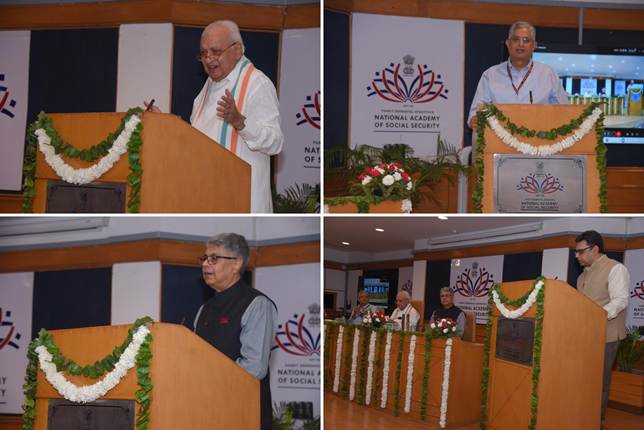
EPFO officers were asked to consider the circumstances of workers and pensioners when applying rules at an August 31, 2026 governance session. Arif Mohammed Khan's keynote focused on non-discrimination and the responsibilities attached to public authority, while Central Provident Fund Commissioner Ramesh Krishnamurthi brought the discussion specifically to claims, pensions and grievances.
The Reimagining Governance: Discourse for Excellence session was organised under the Pandit Deendayal Upadhyaya National Academy of Social Security. Senior EPFO and academy officials participated, with field-office officers joining online from across India, according to the Labour Ministry's September 1 account. It was the second edition of the programme's second season.
Khan argued that technology and procedures could not replace honesty, restraint and sensitivity in officials' decisions. An interactive discussion, moderated by regional provident fund commissioner Prashant Sharma, considered how to balance rules with individual circumstances in technology-enabled administration. Krishnamurthi linked that responsibility to the workers, pensioners and families served by EPFO.
The organisation's digital transition already included specific changes affecting those services. In a February 12 parliamentary reply, the Labour Ministry said the Centralized Pension Payment System allowed pension disbursement through any bank branch across India. A pensioner changing location, bank or branch would no longer need the Pension Payment Order transferred between EPFO offices.
The same reply described Aadhaar face authentication through the UMANG app for generating and activating Universal Account Numbers, introduced in April 2025. It also explained that claims passing risk-management checks were designed for automatic processing without manual intervention, with processing reduced from up to 20 days to under three days for that qualifying route.
Minister of State Shobha Karandlaje told the Rajya Sabha that zonal and field offices reviewed both the quantity and quality of grievance resolution. Those meetings examined underlying causes so recurring issues could be taken up for system changes.