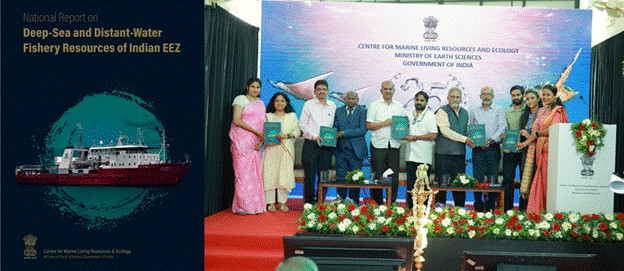
A national review of deep-sea and distant-water fishery resources brings together surveys aboard FORV Sagar Sampada, other datasets and scientific literature. The Earth Sciences Ministry reported its release on August 20, 2026; CMLRE subsequently described it on its own website.
The ministry traces the research programme to more than 400 cruises since the early 1990s. Among the habitats discussed is the mesopelagic, or twilight, zone between 200 and 1,000 metres, including lanternfishes, shrimps and cephalopods.
These animals matter beyond their possible use as catch. NOAA explains that many marine animals rise towards food-rich surface waters at night and descend before daylight, reducing exposure to predators that hunt by sight. Feeding near the surface and releasing waste at depth helps transport carbon downwards.
This creates a specific management question: how would removing organisms affect both food webs and the movement of carbon? A map of abundance alone cannot answer it; depth, migration behaviour and ecological interactions also matter.
CMLRE identifies knowledge gaps and improved observation as priorities. Tracking where organisms live, how they move and how their populations change can connect resource assessment with the ecological processes that sustain the wider sea.