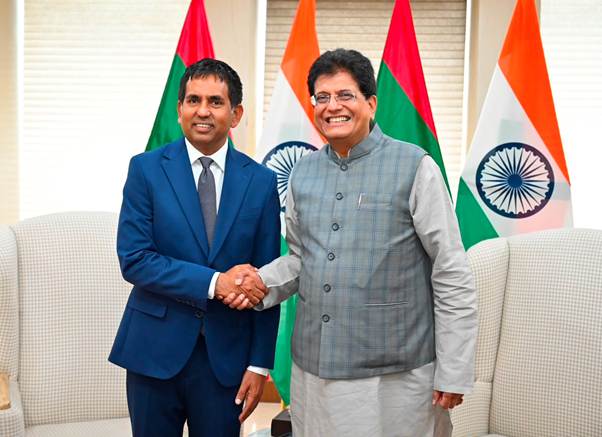
India and the Maldives completed their first round of free-trade negotiations between June 29 and July 7, 2026. India's Commerce Ministry said the virtual discussions covered eight policy areas and were followed by a July 8 ministerial meeting. The commercial backdrop is a relationship in which India is a major supplier but a much smaller destination for Maldivian goods.
The ministry put bilateral trade at $771.76 million in the 2025-26 financial year, up from $679.70 million a year earlier. Ministers also discussed a separate investment treaty and cooperation in tourism, startups, digital payments and smaller businesses. The published account did not identify the eight negotiating areas individually.
A European Commission factsheet using IMF data shows the imbalance from the Maldives' perspective. For calendar 2025, it lists goods imports from India at EUR 517 million, representing 15.6% of Maldivian imports. Exports to India were about EUR 3 million, or 2.5% of exports. These are calendar-year euro figures, not another version of India's financial-year dollar total.
The Maldives Monetary Authority's March 2026 statistical bulletin adds the missing product context. Its customs-based table records $144.6 million of domestic exports in 2025, of which $134.9 million were fish exports. That is roughly 93%, calculated from the published values. Fresh, chilled or frozen tuna alone accounted for $94 million.
The same table separately records $299.2 million of re-exports. Combining those with domestic exports produces a much larger headline total, but would obscure the products generated by the domestic export economy. Fish market access therefore has a different commercial significance from the movement of goods originally imported and subsequently exported again.
Together, the tables explain why reciprocal access need not mean matching sales of similar products. India enters the talks as an established supplier; the Maldives has a concentrated domestic export base. For Maldivian producers, expanding sales requires finding buyers for that specific output, while import-side discussions concern an already substantial supply relationship.