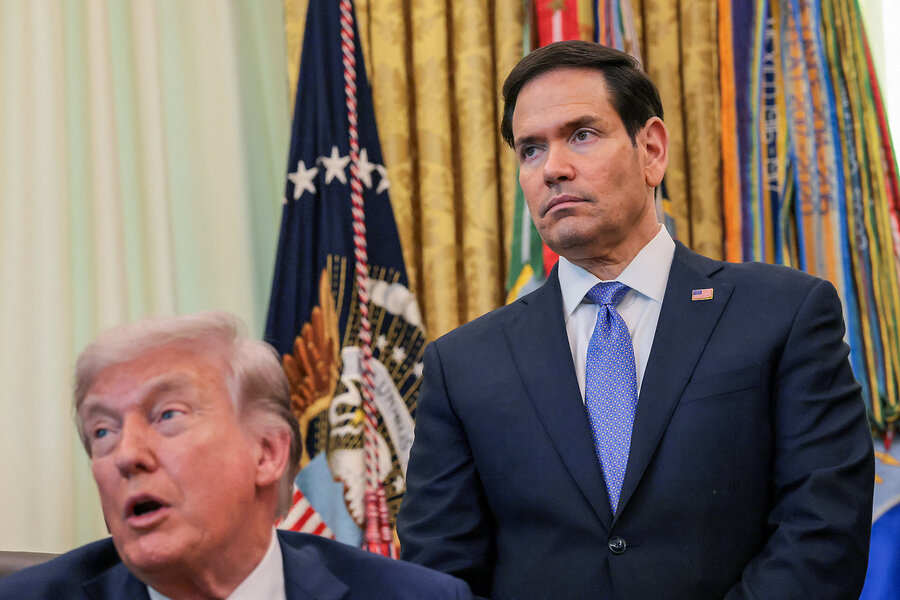
As a United States senator from Florida, Marco Rubio was a high-profile “neocon” – a hawk on China and Russia, a strong supporter of Taiwan, Ukraine, and NATO, and an advocate for free trade and human rights.
Today, not so much – at least on those issues.
As both secretary of State and acting national security adviser, Secretary Rubio is fully on board with President Donald Trump’s approach to foreign policy: more “Art of the Deal” use of American leverage, including tariffs, less hard-line absolutism with other major powers.
After all, he is no longer his own boss; he works for President Trump – in two key capacities, the first to hold both titles since Henry Kissinger in the 1970s.
That comes with perks, including (as national security adviser) an office steps away from the Oval Office and, last week, a ringside seat at the high-stakes presidential summit in China.
Rubio has risen to the challenge, foreign policy analysts say, in how he blended his own core Reaganite neoconservative, pro-interventionist views and the “America First” nationalism of the Trumpist “Make America Great Again,” or MAGA, movement.
“I have been genuinely surprised that he has not only survived but thrived in this administration,” says Daniel Drezner, a professor at Tufts University’s Fletcher School of Law and Diplomacy.
“There were a lot of reasons to think he was going to be the first one out.”.
For starters, Professor Drezner adds, “MAGA didn’t trust him, obviously, as a former neocon.”.
The international significance depends on official statements, diplomatic follow-up and any humanitarian, trade, security or travel implications that emerge after the first report.
For India-facing readers, the immediate relevance is whether the development affects diplomacy, citizens abroad, international law, trade routes, humanitarian operations or multilateral negotiations.