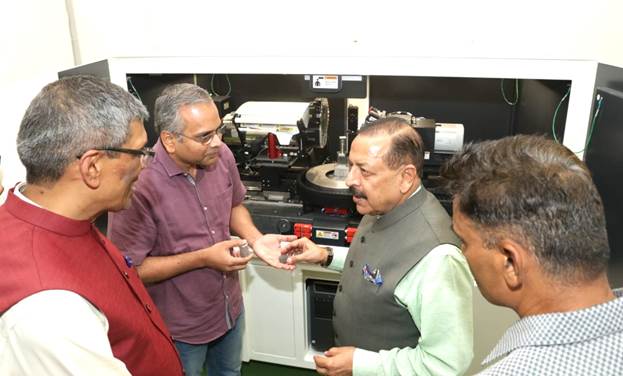
IIT Gandhinagar launched three research clusters and inaugurated a Department of Science and Technology-funded Central Instrumentation Facility on June 11, 2026. The Science Ministry identified advanced materials, energy, and healthcare and medical technology as the cluster areas, with nearly 70 industries joining as founding partners.
The ministry described an intended progression from research to pilot development, validation and technology transfer. It also reported that the institute's research park hosted more than 20 companies and supported over 30 startups. That setting puts the shared facility alongside organisations seeking to develop technologies, rather than treating laboratory equipment as an isolated campus asset.
The institute's published instrument catalogue makes the facility's role more concrete. Its field-emission scanning electron microscope can examine surface form, particle size and size distribution, with an additional mode for elemental analysis. Listed uses include examining micro-cracks and fractures and estimating thin-film thickness. These are measurements of a material's structure and composition, not simply higher-magnification photographs.
Other instruments answer different questions. The catalogue identifies single-crystal X-ray diffraction for determining crystal structure and liquid chromatography-mass spectrometry for molecular-weight information associated with separated peaks. Combining access to such techniques allows a research question to be approached through more than one kind of measurement. The choice depends on what the researcher needs to establish about the sample.
The booking route also extends beyond the institute. IIT Gandhinagar publishes separate arrangements for internal and external users and asks for a separate analysis request for each instrument or facility. Its booking page also directs institutes, universities, industry and research organisations to the iSTEM platform. Shared access therefore has a practical workflow: identify the analysis needed and request the relevant facility. It connects outside researchers to specific measurement services, rather than requiring every organisation to maintain the entire instrument collection itself.