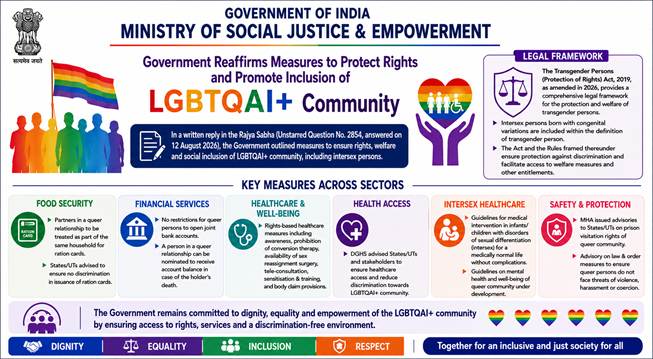
The government's August 13, 2026 parliamentary reply on LGBTQAI+ inclusion referred to banking arrangements that had already been clarified two years earlier. The Social Justice Ministry said people in queer relationships could open joint bank accounts and nominate a partner to receive the account balance after the holder's death.
The Department of Financial Services advisory is dated August 28, 2024. It records that the Reserve Bank had issued a related clarification to scheduled commercial banks on August 21. The advisory addresses access to two ordinary banking facilities, making the banking passage in the August reply a restatement of an existing position.
Joint ownership of an account and nomination perform different functions. The first establishes an account involving more than one holder. The second identifies a recipient after death. Treating the two as equivalent can obscure which arrangement a bank is being asked to record and at what point it becomes relevant.
Central Bank of India's published policy for 2026-27 supplies a concrete example of the settlement rules. It states that a nominee's right in a joint deposit account arises after all depositors have died. A surviving joint holder and a nominated recipient therefore occupy different positions in that bank's payment process.
The same policy says nominees or survivors receive payment as trustees of the legal heirs, and payment does not extinguish others' claims. This separates the bank's authority to release money from the ultimate entitlement to retain it. The clarification of access for queer customers operates within that distinction.
The wider parliamentary reply also addressed ration-card households, healthcare and safety. Banking inclusion has its own administrative work: recording account holders, recording nominations and processing a later claim. The 2024 advisory establishes access, while the bank's policy shows why correct account instructions and succession questions remain separate parts of the process.