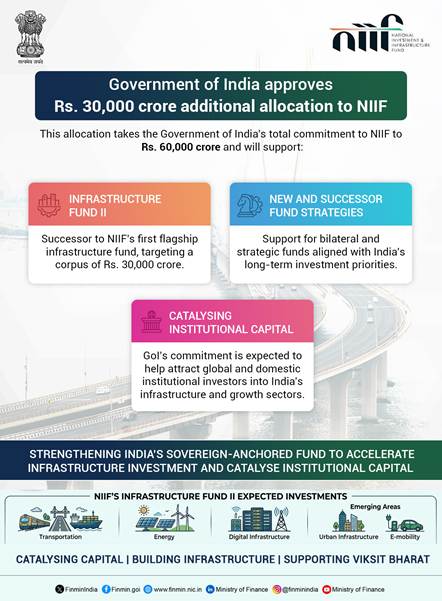
The Centre increased its cumulative commitment to the National Investment and Infrastructure Fund to Rs 60,000 crore, the Finance Ministry announced on 29 June 2026. The additional Rs 30,000 crore was intended for new and upcoming funds, including a second infrastructure fund.
The announcement identifies transport, energy and digital infrastructure among the intended investment areas. It does not mean Rs 30,000 crore of projects were completed, or that the entire commitment was immediately spent. A commitment to funds and expenditure by underlying businesses describe different stages of investment.
There is now a later milestone to distinguish from the June approval. NIIF's website lists an announcement dated 31 August reporting a Rs 19,000 crore first close for Infrastructure Fund II. That is a fundraising development; it should not be added to the government's June commitment as if both figures represented separate project expenditure.
NIIF describes itself as a government-anchored investment manager that raises the majority of capital across its funds from domestic and international institutional investors. Its stated approach uses equity and structured debt on a commercial basis. This is therefore an investment structure, not a direct household benefit or an entitlement to a government grant.
For readers assessing the infrastructure impact, the useful sequence is commitment, fundraising, investment and delivery. The June release and the August announcement document different points in that sequence. Neither figure alone measures completed roads, additional power capacity or returns earned by investors.
Sources and editorial note
- Finance Ministry announcement, 29 June 2026
- NIIF: investment model and 31 August fundraising announcement
Updated 12 October 2026: rewritten with source-linked explanation. The original publication date and article URL are retained.