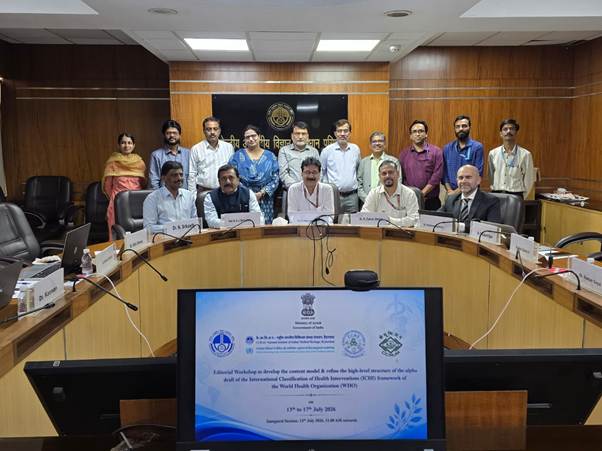
The Ayush Ministry opened a July 13-17 editorial workshop in Hyderabad on traditional-medicine interventions and the WHO International Classification of Health Interventions, or ICHI. The release describes work on Ayurveda, Siddha and Unani content, including the organisation of procedure descriptions.
The task is a records problem with practical consequences. If different services describe the same activity differently, their records can be difficult to compare. A classification provides a structured vocabulary for recording interventions, rather than leaving every institution to invent its own labels.
WHO explains ICHI through three elements: what an intervention targets, what action is performed and the means used. It covers a wide range of health activities, including diagnostic, medical, surgical, rehabilitation and public-health interventions. Additional codes can supply detail where it is needed.
That structure helps explain why an editorial workshop may examine terminology and categories. It does not follow that every draft entry has been finally adopted by WHO, or that every procedure described has demonstrated benefit. The ministry's account of content development is not a completed approval record for all proposed codes.
Classification and clinical evaluation answer different questions. A code can identify what was done so that records can be assembled or compared. Establishing whether an intervention improves a patient's health requires outcome evidence; a consistent label cannot supply that evidence.
The workshop's significance therefore lies in the possible comparability of documentation. Readers should not interpret participation in a WHO-related classification exercise as a recommendation to undergo a treatment, or as proof that competing procedures have equivalent safety and effectiveness.