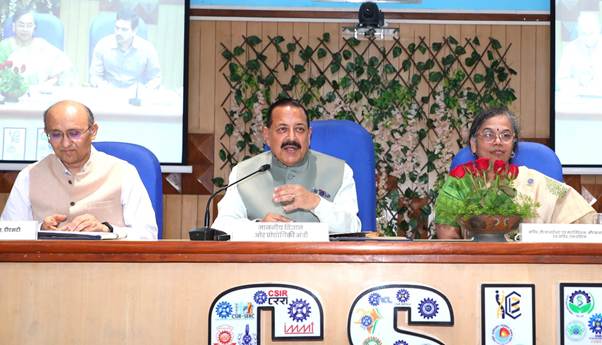
At his June 15, 2026 science review in Delhi, Jitendra Singh described India's bioeconomy as exceeding $190 billion and restated a $300 billion target for 2030. The minister linked that ambition to biotechnology policy and domestic innovation in areas including healthcare, diagnostics and biopharmaceuticals.
A March 25 parliamentary reply supplies the measurement year: it put the bioeconomy at $195.3 billion in 2025, citing the India Bioeconomy Report 2026. The publication year is therefore not the year being measured. The reply reported approximately 18 percent annual growth, while the 2030 figure remained a policy target.
The same reply described a practical route for early ideas. BIRAC's Biotechnology Ignition Grant provides up to Rs 50 lakh over 18 months to establish proof of concept. It also identified a network of 15 shared bio-enabler facilities intended to support pilot and pre-commercial work. Testing whether an idea works and preparing a process for larger-scale production are distinct technical steps.
A different financing instrument addresses later development. In February, BIRAC's managing director said its RDI fund would deploy Rs 2,000 crore over up to five years. The ministry described support for technologies at readiness levels four to nine through equity, convertible instruments and long-term debt. This extends the policy discussion beyond initial research grants to the capital needed for industrial development.
There is also a baseline difference in the official accounts. The February statement used $165.7 billion for 2024; the March reply printed $165 billion. Against $195.3 billion, those inputs produce increases of $29.6 billion and $30.3 billion respectively. They should not be interchanged as a precise growth calculation. The more useful policy comparison is between the stages supported: proof-of-concept grants, shared pilot facilities and longer-term scale-up finance serve different needs within the same biotechnology pipeline.